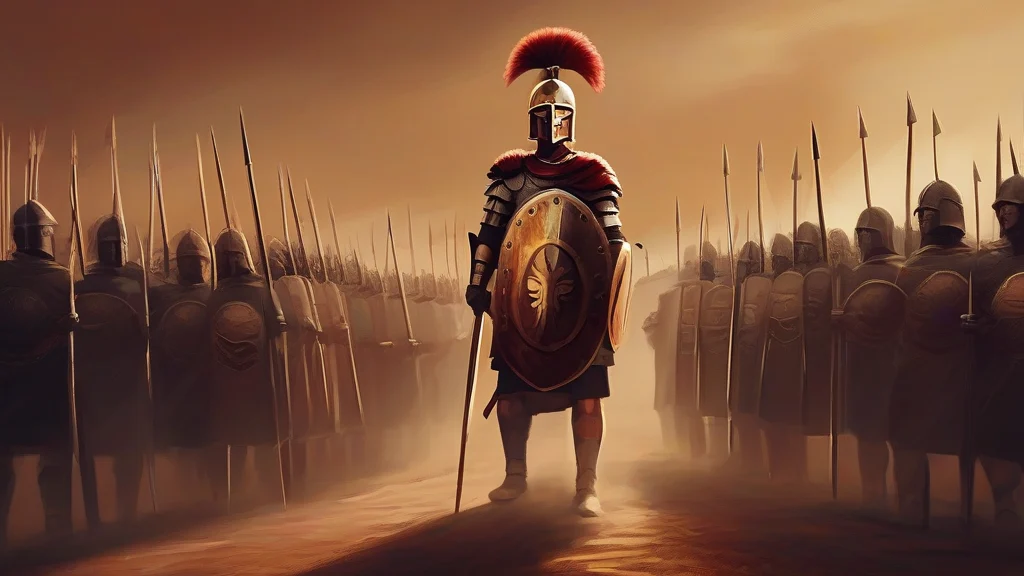
What does centurion mean?
A centurion was a professional officer in the army of ancient Rome, entrusted with commanding a unit known as a century — nominally one hundred legionaries, though in practice often around eighty. Selected largely from experienced soldiers who had risen through the ranks, centurions were the backbone of the legions: they enforced discipline, led their men in battle, and were responsible for training and day-to-day administration. The position carried considerable prestige and pay, and senior centurions could wield influence approaching that of more formally ranked officers. In modern English the word is used almost exclusively in historical, biblical, or literary contexts — the New Testament famously features several centurions — though it can appear figuratively for a strict, commanding figure. It derives from Latin 'centurio', rooted in 'centum', meaning hundred, making it a relative of words like 'century' and 'percent'.
nounAn officer in the ancient Roman army, commanding a century of roughly eighty to one hundred legionary soldiers.
- A professional officer in the Roman army who commanded a century (a unit originally of about one hundred men) within a legion.
- Figurative or literary use for any stern military commander or disciplinarian.
"The centurion barked orders as the legion formed ranks at dawn."
"The centurion earned his men's respect through twenty years of unbroken service on the frontier."
"In the Gospel accounts, a Roman centurion asks Jesus to heal his servant, praising his own chain of command: 'I say to one, Go, and he goeth.'"
Regular plural; used when referring to multiple Roman officers or, rarely, to figures in different armies metaphorically described as centurions.
"The centurions gathered around the general's tent to receive their orders."
Despite the name suggesting a hundred men, a late-Roman centurion often commanded closer to eighty — the title outlived the arithmetic.
Reviewed by Deb Chak, Editor. AI-assisted content curated by RJS Tech Solutions LLP.
Etymology of centurion
Centurion comes from Latin 'centurio', meaning an officer over a hundred soldiers, itself derived from 'centum', the Latin word for hundred. The word entered English via Old French in the medieval period, with its modern form established by the early modern era. Its cognates include 'century', 'centennial', and 'percent', all tracing back to the same Latin root 'centum', which ultimately derives from Proto-Indo-European '*ḱm̥tóm'.
How centurion is actually used
The literal sense refers specifically to the ancient Roman army and is standard in historical writing. Figurative uses are literary and somewhat old-fashioned. The word is formal-to-neutral in register; it carries connotations of discipline, authority, and martial toughness.
Easily confused with centurion
A centurion was a Roman military officer; a sentinel is any soldier or guard standing watch.