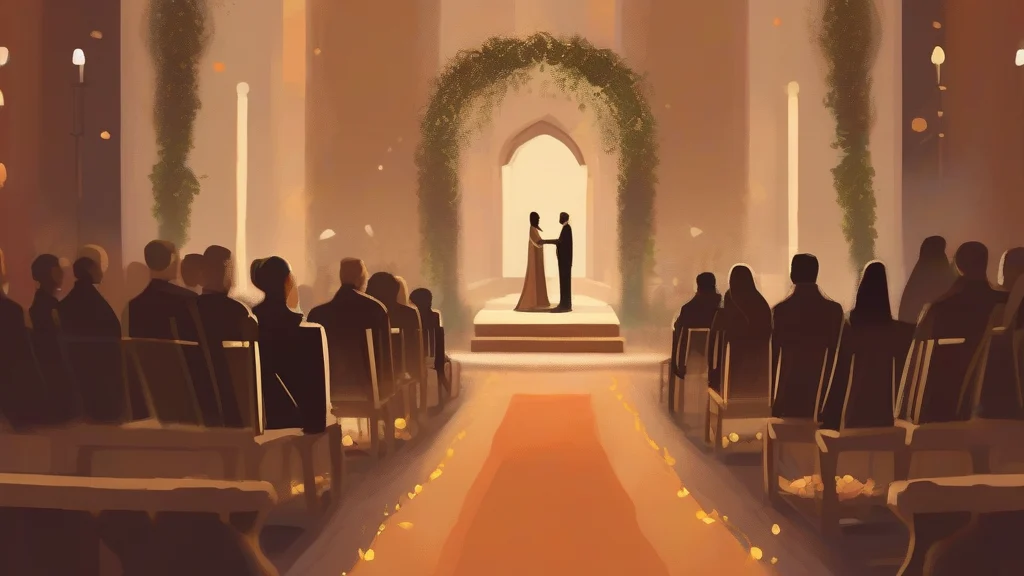
What does ceremony mean?
A ceremony is a formal occasion — often public, religious, or civic — built around a set of established actions performed in a prescribed way. Weddings, graduations, inaugurations, funerals, and award presentations are all familiar examples, each following a recognizable sequence of readings, vows, speeches, or symbolic gestures that give the event its meaning and weight. Beyond naming the event itself, "ceremony" can refer to the rituals observed within it, as in "the ceremony lasted two hours." The word also extends figuratively: to do something "without ceremony" is to do it briskly and informally, skipping the usual courtesies. Derived forms include the adjective "ceremonial," describing objects or attire associated with formal occasions, and "ceremonious," describing overly polite or punctilious behavior. Rooted in the Latin caerimonia, referring to sacred rites of ancient Rome, the word carries connotations of dignity, tradition, and solemnity, making it central to how cultures mark life's most significant transitions.
A formal act or series of acts performed according to established custom, especially on a religious, public, or solemn occasion.
"The coronation ceremony drew crowds from across the nation."
Often modified by adjectives specifying type: wedding ceremony, opening ceremony, religious ceremony.
Excessive formality or punctilious politeness in social behavior.
"She waved off the compliments without ceremony and got straight to work."
Usually found in negative constructions like "without ceremony" or in the idiom "stand on ceremony."
Used when referring to multiple distinct formal events, or to the collective rites of different cultures and traditions.
"Anthropologists have documented the initiation ceremonies of many indigenous cultures."
Every time you say "without further ado," you're echoing centuries of ceremony — the word traces back to Latin caerimonia, the sacred rites of ancient Roman religion.
Reviewed by Deb Chak, Editor. AI-assisted content curated by RJS Tech Solutions LLP.
Etymology of ceremony
The English word "ceremony" derives from the Latin caerimonia, which referred to sacred rites and religious observances in ancient Rome. It entered Middle English via Old French ceremonie around the late Middle Ages. Cognates appear throughout Romance languages, including French cérémonie, Italian cerimonia, and Spanish ceremonia, all tracing back to the same Latin root. The precise origin of caerimonia itself remains debated among scholars.
Related word forms
How ceremony is actually used
In everyday speech, "without ceremony" means informally or abruptly. The plural is rare but appears when referring to multiple distinct events. The phrase "stand on ceremony" means to insist on strict formality. The word carries a connotation of dignity and solemnity, though it can be used ironically to suggest unnecessary pomp.
Easily confused with ceremony
"Ceremony" is the noun naming the formal event itself, while "ceremonial" is primarily an adjective describing things relating to or used in ceremonies (though it can also serve as a noun for ceremonial garments).
"Ceremony" refers to the formal event, while "ceremonious" describes behavior that is extremely polite and formal, sometimes to an excessive degree.