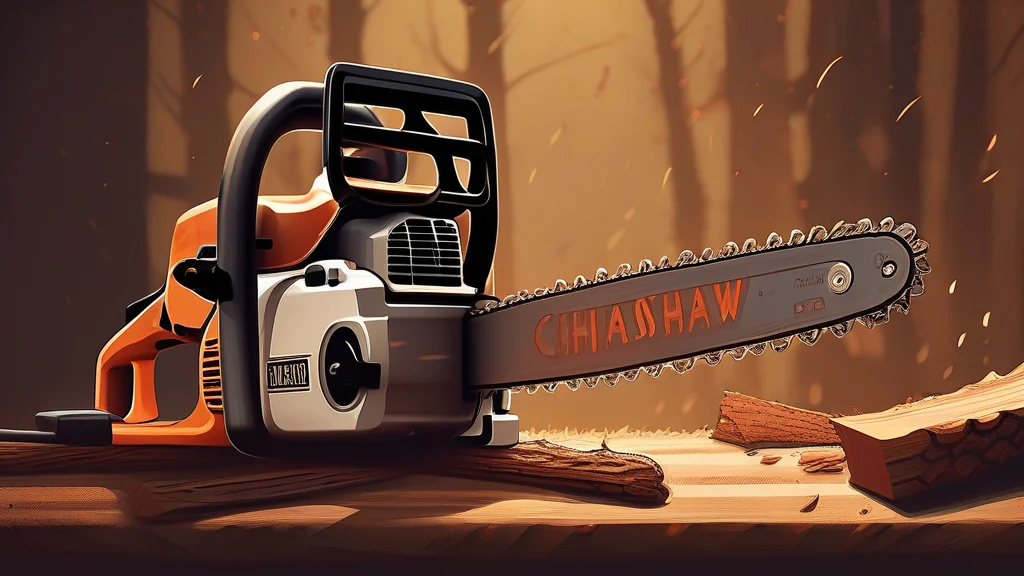
What does chainsaw mean?
A chainsaw is a portable power tool designed for cutting wood, most commonly trees. It works by driving an endlessly looping toothed chain at high speed along a narrow guide bar; when the spinning chain is pressed against timber, its sharp cutters slice rapidly through even thick trunks. Chainsaws are powered either by small two-stroke petrol engines or by electric motors, including modern battery models, and they are indispensable to loggers, arborists, landscapers, and homeowners alike. Because of their power and inherent danger, using one safely demands protective equipment and training, which has given the word a connotation of raw, somewhat hazardous force. This intensity carries into figurative speech: journalists may write that a politician 'took a chainsaw to' a budget, implying drastic, sweeping cuts. The word entered general usage in the twentieth century as mechanized logging spread, and it remains a vivid, concrete noun that instantly evokes both industry and menace.
A portable mechanical saw driven by a motor, with a set of sharp teeth attached to a rotating chain that runs along a guide bar, used mainly for felling trees, pruning, and cutting firewood.
"Wearing ear defenders, she guided the chainsaw steadily through the trunk."
Often modified by power source: 'petrol/gas chainsaw', 'electric chainsaw', 'battery chainsaw'.
To cut something down or apart using a chainsaw.
"The crew spent the morning chainsawing the storm-felled oaks into manageable logs."
Inflected forms include chainsawed/chainsawed (or chainsawn) and chainsawing; chiefly North American and informal.
Regular plural; standard in all varieties of English.
"All three chainsaws were lined up on the workbench for servicing."
The chainsaw's earliest ancestor was invented in the 1780s as a surgical instrument to help widen the pelvic opening during childbirth — its woodworking career came decades later.
Reviewed by Deb Chak, Editor. AI-assisted content curated by RJS Tech Solutions LLP.
Etymology of chainsaw
Chainsaw combines 'chain', borrowed from Old French chaine and ultimately from Latin catena meaning 'chain', with 'saw', from Old English sagu of Germanic origin. The compound arose in the late nineteenth century as inventors applied continuous-chain mechanisms to cutting tools, and it became widespread during the twentieth century with the rise of mechanized forestry. Its Latin root catena also yields English words such as 'concatenate' and 'catenary', reflecting the same idea of things linked together.
Related word forms
How chainsaw is actually used
Informal to neutral register; the figurative use ('take a chainsaw to') is journalistic and slightly informal. British English traditionally favours 'petrol-driven' while American English uses 'gas-powered'.
Easily confused with chainsaw
A hacksaw is a small hand-held saw with a fine blade for cutting metal, whereas a chainsaw is a motorized tool with a toothed chain for cutting wood.