
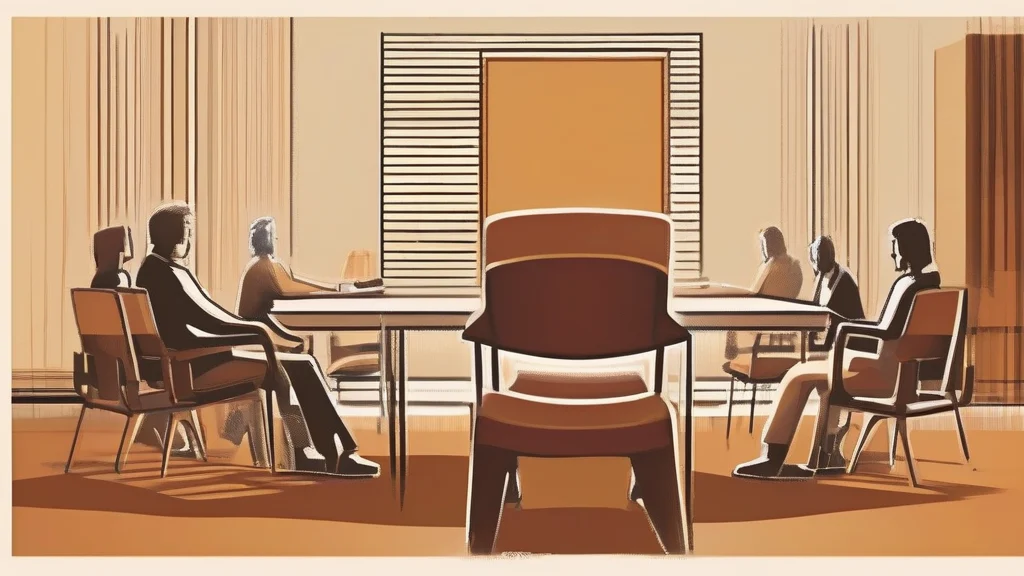
What does chair mean?
A chair is a piece of furniture designed for one person to sit on, typically comprising a seat raised on legs, a backrest, and sometimes arms. It is among the most fundamental objects of everyday life, appearing in countless domestic, workplace, and public settings, with forms ranging from simple wooden stools-with-backs to elaborate thrones symbolizing authority. Beyond furniture, 'chair' carries an important figurative meaning: it denotes the person presiding over a meeting, committee, board, or organization, or the position itself — as when someone is elected chair of a department or holds a university chair, meaning a professorship. This sense derives from the historic association between seats of honour and authority, seen in phrases like 'the chair' of a company or the cathedra of a bishop, which also gave English the word 'cathedral'. The word functions chiefly as a noun but is also used as a verb meaning to preside over a meeting. Neutral in register and universally understood across the English-speaking world, 'chair' is both an everyday practical term and a word with rich connotations of power and precedence.
A separate seat for one person, typically having a back and four legs.
"There were six chairs arranged around the table."
In extended use, 'chair' denotes a seat of authority, such as a professorship or the presiding officer's position.
The person who presides over a meeting, committee, or organization; the office or position of such a person.
"The chair called the meeting to order."
Widely used as a gender-neutral alternative to 'chairman'.
To act as the chairperson of; to preside over (a meeting or organization).
"She will chair tomorrow's session on climate policy."
Standard regular plural. The plural can refer either to multiple pieces of furniture or, less commonly, to multiple presiding officers.
"The hall was filled with rows of folding chairs."
'Chair' travelled from ancient Greek through Latin and French before reaching English — and along the way it gave us 'cathedral', literally a building built around a bishop's chair.
Reviewed by Deb Chak, Editor. AI-assisted content curated by RJS Tech Solutions LLP.
Etymology of chair
The word 'chair' entered Middle English in the 13th century from Old French 'chaiere', which derived from Latin 'cathedra', itself borrowed from Greek 'kathedra', meaning 'seat'. Because chairs were historically rare and costly — benches and stools being the norm — the word carried associations of dignity and authority, reflected in expressions such as 'taking the chair'. The same Greek root gives English 'cathedral' (a church housing a bishop's seat), 'cathedra', and the related borrowing 'chaise'.
Related word forms
How chair is actually used
As a noun for the presiding officer, 'chair' is now widely preferred as gender-neutral over 'chairman'; it can refer to either the person or the role ('she was appointed to the chair'). As a verb, 'to chair' means to preside over a meeting. In British English 'take the chair' is a formal idiom meaning to assume the presidency of a meeting.
Easily confused with chair
A chaise is a light open carriage, historically borrowed from the same French source as 'chair', but refers to a vehicle (or a long reclining seat in 'chaise longue'), not an ordinary chair.