What does challah mean?
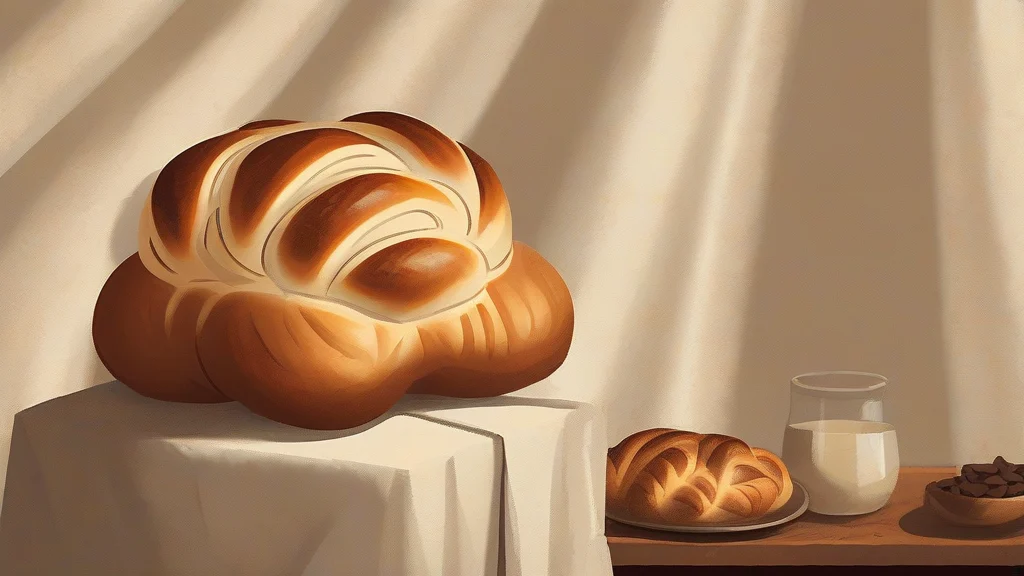
Challah is a soft, enriched bread made with eggs and often a touch of honey or sugar, instantly recognizable by its glossy, braided crust. It occupies a central place in Jewish culinary tradition, where loaves are baked for the Sabbath dinner and for holidays such as Rosh Hashanah, when the braid may be shaped into a round to symbolize continuity. The name derives from Hebrew, where "challah" originally denoted the small portion of dough that religious law requires be separated and given to the priests — a practice still observed symbolically today. In contemporary English, the word appears most often in food writing and home kitchens, and the bread has crossed cultural lines entirely: dense, slightly sweet slices of day-old challah are prized for French toast and sandwiches. Rich yet unpretentious, the word carries connotations of family, ritual, hospitality, and comfort, making it a beloved fixture of both sacred tables and weekend brunches.
A leavened bread enriched with eggs and often sugar or honey, typically braided and eaten on the Jewish Sabbath and festivals.
"The bakery sells out of challah every Friday morning."
Both singular and plural forms are common in English; the Hebrew-style plural "challot" also appears.
In Jewish ritual law, the portion of dough separated from each batch of bread and given to the priests.
"She performed the mitzvah of separating challah before baking."
This is the original, technical sense of the Hebrew term, now less common in everyday English.
Most English speakers simply use the singular form unchanged or add -s; the Hebrew plural "challot" appears in more traditional contexts.
"Three braided challahs rested on the bakery counter."
That golden braided loaf on the Sabbath table gets its shine from an ancient tradition: a piece of every batch was once set aside as a tithe for the priests.
Reviewed by Deb Chak, Editor. AI-assisted content curated by RJS Tech Solutions LLP.
Etymology of challah
Challah comes from Hebrew ḥallāh (חלה), which originally referred not to the loaf itself but to the portion of dough set aside as a tithe under biblical law before the rest was baked. The word entered English through Yiddish, carried by Ashkenazi Jewish communities who used "challah" to mean the special braided Sabbath bread, and it became established in American English in the nineteenth century alongside large waves of Jewish immigration. It shares its Semitic root with other Hebrew-derived words adopted into English via Jewish life, such as cholent, the slow-cooked Sabbath stew.
How challah is actually used
The word is fully naturalized in English and needs no italics. The plural is usually left unchanged ("two challot" in Hebrew-influenced usage is also heard). Pronunciation varies: many speakers anglicize it as "HAH-luh" or even rhyme the first syllable loosely with "call," but the standard English pronunciation begins with an h sound.
Easily confused with challah
"Hallah" is simply an older or alternative transliteration of the same Hebrew word; both spellings refer to the identical braided egg bread.