What does chamfrain mean?
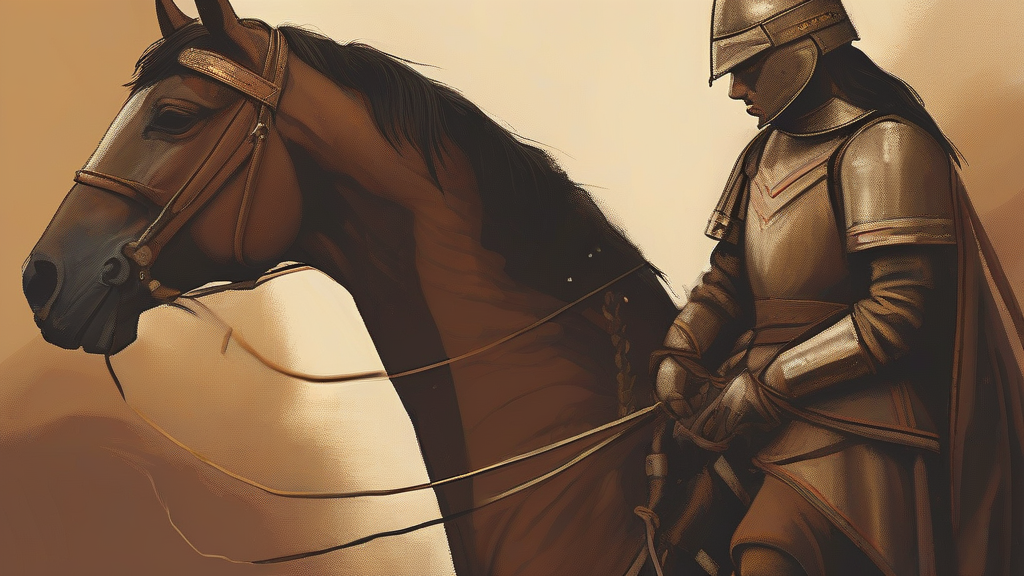
A chamfrain is the armoured plate designed to protect a horse's face and forehead, forming part of the full bard — or horse armour — worn by warhorses in the medieval period. Fitted over the animal's head, it shielded the most vulnerable forward-facing part of the horse during battle and tournament, and was often crafted with the same care and decoration as the rider's own harness, sometimes bearing engraved heraldic devices. Today the word survives almost exclusively in specialist contexts such as arms-and-armour scholarship, museum cataloguing, and historical writing about knighthood and cavalry. Readers are more likely to meet the closely related spellings 'chamfron', 'chanfron', or 'shaffron', all referring to the same object; 'chamfrain' is best treated as a variant form. Despite its rarity, the word offers a vivid reminder that medieval warfare armoured horses as elaborately as it did the knights who rode them.
nounA chamfrain is the plate of a horse's armour that protects the animal's face and forehead, used on warhorses in the medieval period. It also appears as an occasional variant form of the word chamfron.
- The plate of a horse's armour covering its face and forehead, as worn by warhorses in the Middle Ages.
- A rare variant spelling of chamfron, the standard modern term for this piece of armour.
"The knight's destrier wore a steel chamfrain engraved with his coat of arms."
"Museum conservators carefully restored the etched chamfrain that once guarded the duke's charger."
"In the tournament lists, each destrier's chamfrain gleamed beneath the heraldic banners."
The plural follows regular English noun inflection and is uncommon outside specialist armour literature.
"The royal collection included several ornately engraved chamfrains from different European courts."
Medieval knights didn't just armour themselves — their horses wore full suits too, and the chamfrain was the piece that turned a warhorse's face into a moving wall of steel.
Reviewed by Deb Chak, Editor. AI-assisted content curated by RJS Tech Solutions LLP.
Etymology of chamfrain
The word derives from the Old French 'chamfrein' (also appearing as 'chanfrein'), which denoted the front piece of a horse's head defence. It entered English through Anglo-Norman during the medieval period, when the vocabulary of knighthood and armour was heavily borrowed from French. It shares its ultimate origin with 'chamfer', the carpentry term for a bevelled edge, both tracing back to the same Old French root. In modern usage the anglicised forms 'chamfron' and 'chanfron' have largely displaced 'chamfrain'.
How chamfrain is actually used
The word belongs to specialist registers — armour studies, medieval history, and museum description — and is rarely encountered in general conversation. The spelling 'chamfron' (alongside 'chanfron' and 'shaffron') is considerably more common in modern scholarship, so 'chamfrain' may read as archaic or dialectal even to specialists.
Easily confused with chamfrain
A chamfer is a bevelled or sloped edge cut into wood or stone in carpentry and masonry, whereas a chamfrain is a piece of medieval horse armour protecting the face.
A chamfron is simply the more standard spelling of the same piece of horse armour; chamfrain is a less common variant.