What does chanticleer mean?
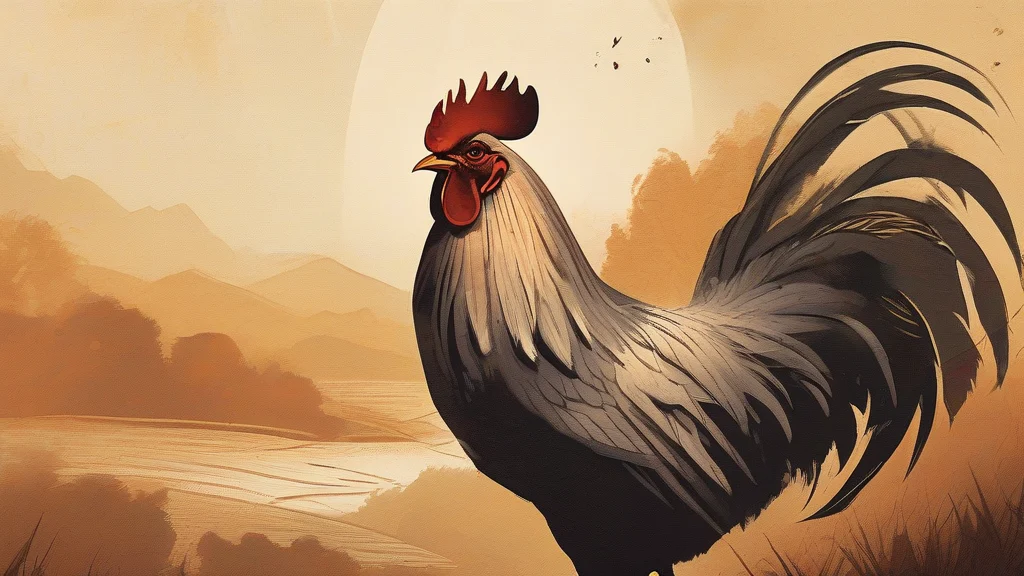
Chanticleer is a literary noun meaning a rooster — specifically the proud barnyard cock who serves as a stock character in medieval European fable. The word entered English through Old French, combining elements meaning 'to sing' and 'clear', so it literally evokes the bird's clear morning crow. Its most famous appearances are in the beast-epic Reynard the Fox and in Geoffrey Chaucer's Nun's Priest's Tale, where the eloquent, somewhat vain Chanticleer is nearly tricked by a flattering fox — an episode that has made him an enduring symbol of vanity undone by smooth talk. Today the word survives mainly in literary, historical, or deliberately whimsical contexts: writers reach for 'chanticleer' when they want an elevated or archaic flavor that plain words like rooster or cockerel cannot supply. It is almost never used in everyday conversation about actual poultry, but its long pedigree makes it a favorite among readers of classic literature.
nounA rooster, especially one featured as a character in medieval fable and literature; used chiefly as a literary or humorous name for a cockerel.
- A rooster or cockerel, especially as a character name in fable and literature (as in Reynard the Fox and Chaucer's Nun's Priest's Tale).
"At dawn, chanticleer crowed from the fence post and the farmyard slowly stirred to life."
"When chanticleer announced the dawn from his perch, the whole village knew morning had arrived."
"In the medieval tale, the fox's flattery nearly costs the proud chanticleer his life."
The standard plural adds -s; the word is rarely needed in the plural since it typically refers to a single celebrated rooster.
"At daybreak the chanticleers of the neighboring farms answered one another across the valley."
Chaucer's vain rooster Chanticleer nearly loses his life to a fox because he can't resist flattery — making this word a 600-year-old warning about ego.
Reviewed by Deb Chak, Editor. AI-assisted content curated by RJS Tech Solutions LLP.
Etymology of chanticleer
Chanticleer comes from Old French chantecler, formed from chanter ('to sing') plus cler ('clear'), literally 'sing clear' — a fitting description of a crowing cock. The term was popularized across medieval Europe as the name of the rooster in the beast-fable tradition, notably in the Roman de Renart and later in Chaucer's Nun's Priest's Tale, which fixed it firmly in English. English borrowed the word in the Middle French period, and it has retained its literary, slightly archaic coloring ever since.
How chanticleer is actually used
The word is literary and somewhat archaic; it appears most often in allusions to medieval literature, particularly Chaucer, rather than in everyday speech. It is frequently capitalized when referring to the specific fable character. In ordinary contexts, 'rooster' (US) or 'cock'/'cockerel' (British) is preferred.
Easily confused with chanticleer
A chandler is a dealer in candles or ships' supplies, whereas a chanticleer is a rooster — the two words merely resemble each other in spelling.