
What does charkha mean?
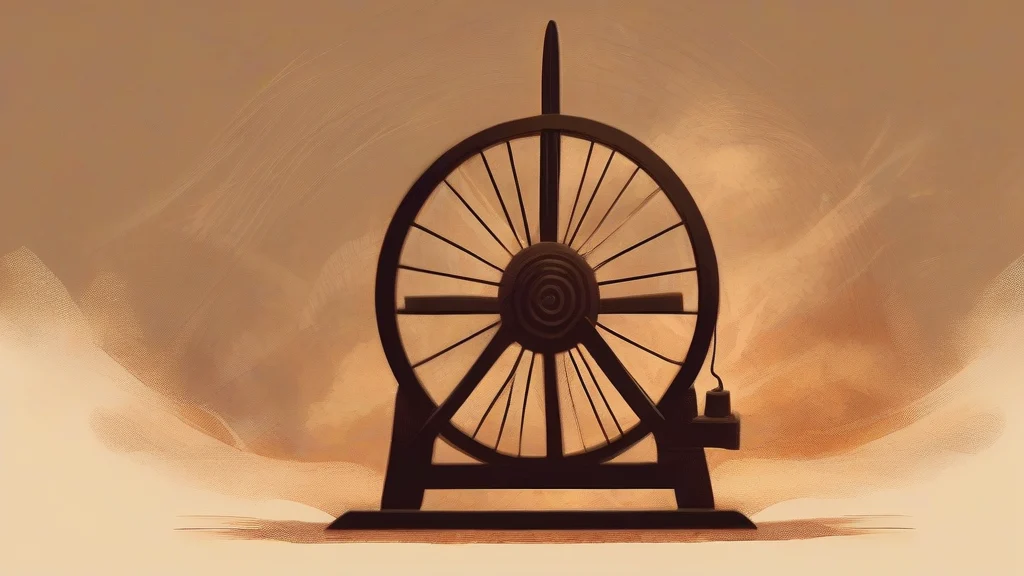
Charkha is the English name for a traditional South Asian spinning wheel, a device operated by hand to draw and twist fibres such as cotton into thread. Its familiar wooden form typically includes a large drive wheel, a spindle, and a mechanism for controlling the thread. Beyond its practical use in textile production, the charkha became a powerful political symbol through Mahatma Gandhi, who promoted hand spinning as a means of economic self-reliance, opposition to colonial manufacturing, and support for swaraj, or self-rule. Today, references to charkhas commonly occur in discussions of Indian crafts, rural and traditional life, the independence movement, and Gandhian philosophy. Although “spinning wheel” is the ordinary English description, “charkha” is the more specific South Asian term and carries cultural and historical associations that the generic expression does not.
nounA traditional hand-operated spinning wheel, especially one used in South Asia to twist fibres such as cotton into thread. The word also evokes the spinning and self-reliance associated with Mahatma Gandhi.
- A traditional South Asian hand-operated spinning wheel used to twist fibres into thread.
- A symbol of the spinning, economic self-reliance, and swaraj associated with Mahatma Gandhi.
"Her grandmother sits beside the charkha, spinning cotton thread by hand."
"She learned to spin cotton on a charkha from her grandmother."
"The museum's display of Gandhi's charkha explained its role as a symbol of Indian self-sufficiency."
The regular English plural is “charkhas,” although singular forms are common when referring to the device as a cultural symbol.
"The exhibition included two charkhas and several hand-spun textiles."
Gandhi transformed the charkha from a tool for spinning thread into a symbol of self-reliance, swaraj, and resistance to colonial rule.
Reviewed by Deb Chak, Editor. AI-assisted content curated by RJS Tech Solutions LLP.
Where does charkha come from?
The English word is a borrowing from Hindi चरखा (charkhā), with closely corresponding forms in Punjabi and Urdu. These forms belong to a wider South Asian vocabulary for a wheel, with cognate words appearing in Sanskrit and Persian; in Urdu, charkh still means “wheel.” The spinning wheel became especially prominent in English through descriptions of Indian craft and Mahatma Gandhi's use of it as a symbol of self-reliance and swaraj.
How charkha is actually used
In present-day English, the word is mainly used in South Asian cultural, historical, and educational contexts. In broader descriptions of textile equipment, “spinning wheel” is more usual.
Easily confused with charkha
A charkha is a physical spinning wheel, whereas a chakra is usually a wheel-like circle or a concept associated with energy centers in yoga.