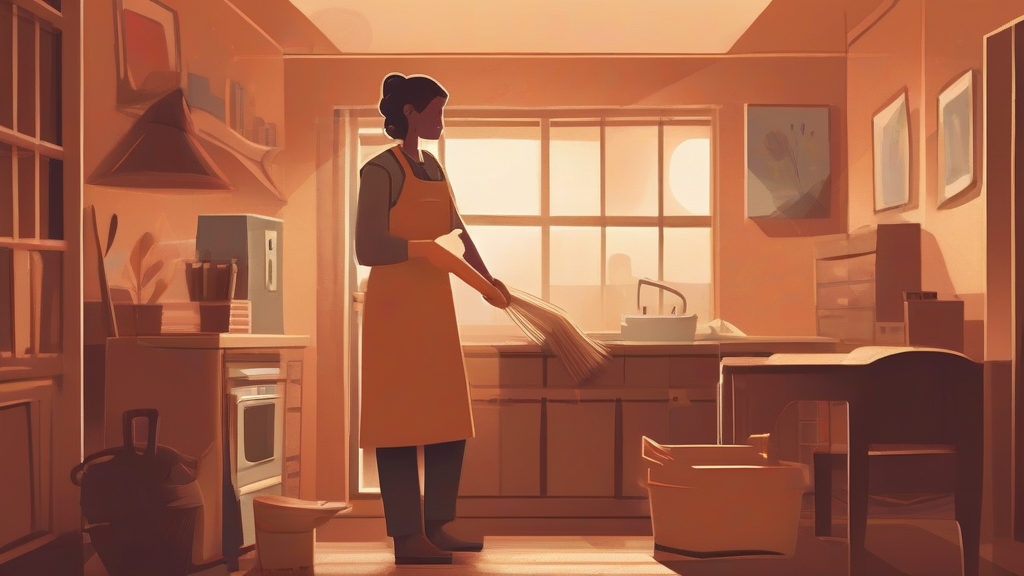
What does charlady mean?
Charlady is a chiefly British noun denoting a woman who is employed to clean houses, offices, or other premises, typically working by the day rather than living in as a domestic servant. The word combines 'char' — an old word for an odd job or piece of housework — with 'lady,' and it emerged as a familiar, colloquial counterpart to the more formal and older term 'charwoman.' Charlady belongs firmly to the vocabulary of twentieth-century Britain: it evokes the era when working-class women moved from house to house each day, scrubbing floors and lighting fires before returning to their own homes. Today the term sounds distinctly old-fashioned, appearing mainly in historical fiction, memoirs, and nostalgic writing about ordinary lives, since modern speech prefers the plain, neutral word 'cleaner.' Its connotations range warmly affectionate to faintly patronising, so writers use it deliberately to summon a particular time, place, and social texture.
nounA woman employed to clean houses or offices, typically on a daily or part-time basis; the British English equivalent of a cleaning lady.
- A woman employed to do cleaning work in a house or office, usually by the day.
"The old house still smelled of beeswax, for the charlady came every Thursday without fail."
"Mrs. Hobbs worked as a charlady for three families on our street."
"In her memoir she recalls her mother's years as a charlady, scrubbing other people's floors before dawn."
Standard plural; used when referring to more than one such cleaner, often in discussions of domestic labour history.
"The great country houses once depended on armies of cooks and charladies."
'Char' in charlady comes from an Old English word meaning 'to turn' — as in turning to odd tasks — making it a distant cousin of the word 'chore.'
Reviewed by Deb Chak, Editor. AI-assisted content curated by RJS Tech Solutions LLP.
Etymology of charlady
The first element, 'char', derives from Middle English 'cherre' or 'chare', meaning a turn of work or an odd job, which itself traces back to Old English 'cierr' or 'cerr', meaning a turn or occasion — the same root that ultimately gives us the word 'chore'. The compound 'charwoman' was established by the seventeenth century, and 'charlady' arose later as a more colloquial British variant, becoming widespread in the nineteenth and early twentieth centuries. It is thus related to 'chore' and 'charwoman' through this shared Germanic root rather than to any Latin-derived word family.
How charlady is actually used
The word is distinctly British and carries a somewhat old-fashioned, mid-twentieth-century flavour; it can sound quaint, nostalgic, or mildly condescending depending on context. In contemporary usage, 'cleaner' is the neutral everyday term, so charlady is mostly found in historical writing, fiction, and informal reminiscence.
Easily confused with charlady
Both mean a woman hired to clean, but charwoman is the older, now largely dated term, while charlady is its more colloquial twentieth-century British counterpart.