What does chayote mean?
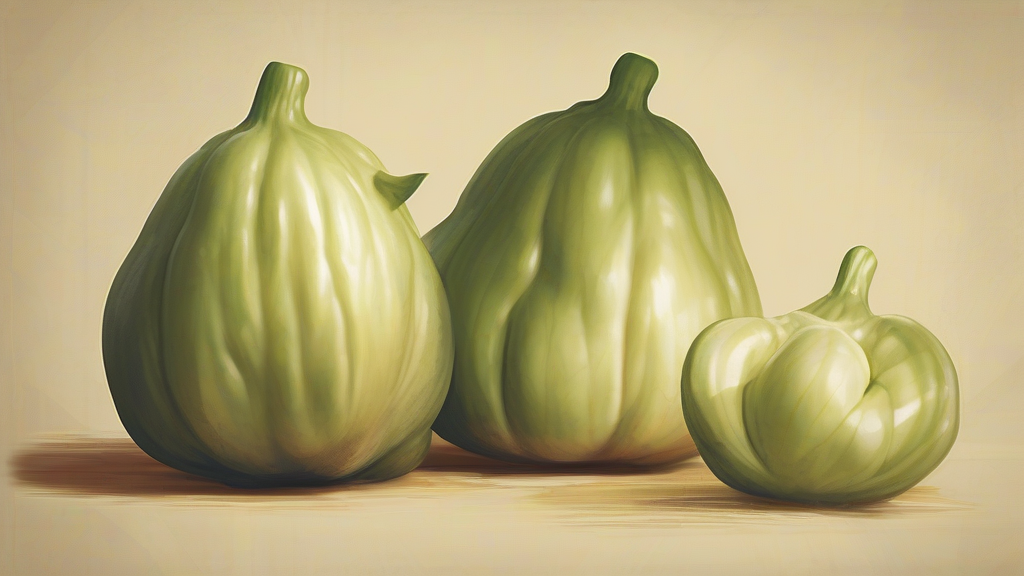
The chayote is the edible fruit of a climbing vine in the gourd family, native to southern Mexico and Central America and cultivated throughout the tropics. Pear-shaped, pale to dark green, and roughly apple- to fist-sized, it has thin edible skin, crisp white flesh, and a single large flattened seed. Its flavour is mild and slightly sweet, somewhere between a cucumber and a summer squash, which makes it remarkably versatile: it can be boiled, baked, stuffed, fried, pickled, or added raw to salads. In much of the world it goes by other names entirely — mirliton in Louisiana, christophene in the French Caribbean, choko in Australia, chocho in Jamaica — reflecting how thoroughly it has been absorbed into local cuisines since spreading from its Mesoamerican homeland after European contact. For cooks seeking a low-calorie, subtly flavoured vegetable, the chayote is a dependable and increasingly available option in international markets.
nounA tropical climbing vine of the gourd family, and the green, pear-shaped fruit it bears, which is eaten as a vegetable. The crisp, mild-flavoured flesh is widely used in Mexican, Caribbean, and Latin American cooking.
- The green, pear-shaped edible fruit of the vine Sechium edule, cooked and eaten as a vegetable.
- The climbing perennial vine (Sechium edule) of the gourd family, native to Mesoamerica, that produces this fruit.
"She simmered the chayote with garlic and onions until the slices turned tender."
"Halve the chayotes, remove the seed, and steam them until just tender."
"In New Orleans markets you'll often find the same vegetable sold under its Cajun name, mirliton."
Standard plural adds -s; the uninflected form may appear when the word functions as a mass noun describing the vegetable generally.
"Buy two or three chayotes for this recipe."
This one vegetable answers to at least half a dozen names around the world — from 'mirliton' in Louisiana to 'christophene' in the Caribbean — all pointing back to a single word borrowed from the Nahuatl language of the Aztecs.
Reviewed by Deb Chak, Editor. AI-assisted content curated by RJS Tech Solutions LLP.
Etymology of chayote
The word chayote entered Spanish from Nahuatl (Aztec), specifically from a form such as 'chayohtli', the name used in central Mexico where the plant was domesticated. Spanish adopted it during the colonial period, and it passed into English through Spanish sources, appearing in English texts by the early nineteenth century as the vegetable spread through the Americas and beyond. Because it derives from an indigenous American language rather than Latin or Greek, it has no true cognates in European languages; related borrowings from Nahuatl include words such as tomato, chocolate, and avocado.
How chayote is actually used
The word is most common in culinary contexts and among cooks familiar with Latin American, Caribbean, and Cajun cuisine. Regional synonyms are so entrenched locally (mirliton, christophene, choko, chocho) that speakers may use them exclusively without knowing the term 'chayote'. The plural is usually 'chayotes', though the uninflected form is sometimes treated as a mass noun when referring to the vegetable generally.
Easily confused with chayote
Chai is a spiced tea (or the word for tea itself in several languages), while chayote is a gourd-like vegetable — the two merely share a similar opening sound.
Cayote is an occasional variant or misspelling referring to the coyote-like plant name; the standard English spelling of the vegetable is chayote, whereas a cayote is not a recognized separate word in standard dictionaries.