
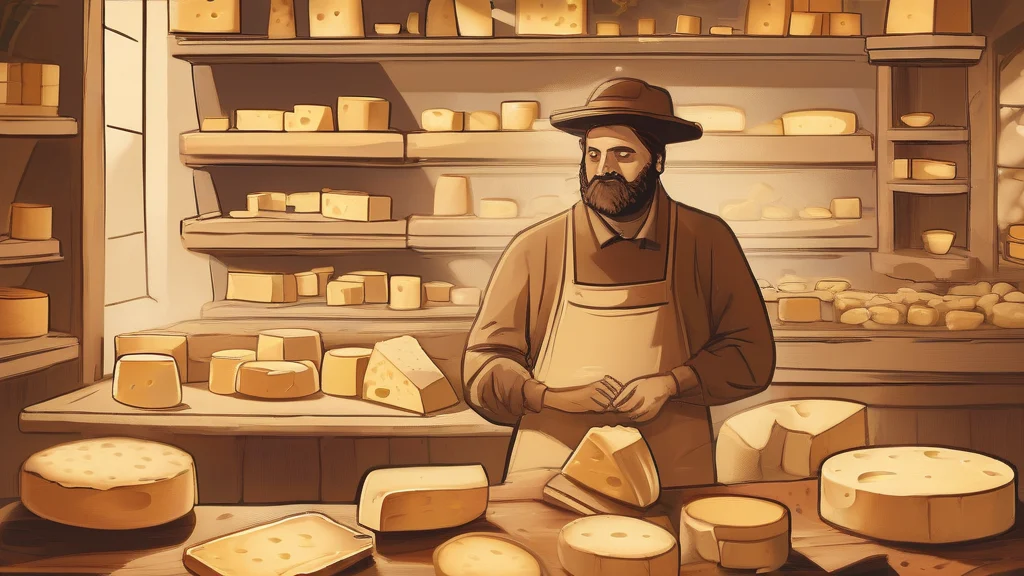
What does cheesemonger mean?
A cheesemonger is a dealer in cheese — traditionally, a person who sells cheese from a market stall or specialty shop, offering customers guidance on selecting, storing, and serving different varieties. The word derives from 'cheese' combined with 'monger', an old English term for a trader or dealer in a particular commodity. Though rooted in centuries-old commerce, the term remains current and has enjoyed renewed visibility with the rise of artisanal and farmstead cheese culture. Today a cheesemonger is expected not merely to sell cheese but to possess genuine expertise: knowledge of milk types, aging processes, regional traditions, and suitable wine or bread pairings. The word can also denote the shop itself, as in 'a fine cheesemonger on the high street'. More common in British English than American, it nonetheless appears widely in food writing on both sides of the Atlantic, where it connotes craftsmanship, tradition, and connoisseurship rather than mere retail.
A person who sells cheese, especially one with expert knowledge of cheese varieties and their selection, storage, and serving.
"The cheesemonger wrapped the wedge of Brie in waxed paper and noted how best to ripen it."
Often connotes a specialist or artisanal retailer rather than a general grocer.
A shop or business that specializes in selling cheese.
"There's an excellent cheesemonger just around the corner from the bakery."
Standard regular plural. When referring collectively to the trade or profession, the singular attributive form is often used, as in 'the cheesemonger's guild'.
"Several local cheesemongers set up stalls at the farmers' market every Saturday."
The word 'cheesemonger' has been around since the Middle Ages — long before anyone thought of pairing cheese with Instagram photos.
Reviewed by Deb Chak, Editor. AI-assisted content curated by RJS Tech Solutions LLP.
Etymology of cheesemonger
Cheesemonger combines 'cheese', from Old English 'cīese' (ultimately from Latin 'caseus'), with 'monger', from Old English 'mangere', meaning trader or merchant, which itself traces back to Latin 'mango', meaning a dealer or slave-dealer. The compound follows the pattern of other English trade words such as fishmonger, ironmonger, and costermonger. It has been used since the medieval period to describe those who made their living selling cheese, and its formation reflects the historical importance of specialized street traders in English towns.
How cheesemonger is actually used
The word carries a slightly traditional or artisanal register; it evokes specialist shops and craft food culture rather than supermarket retail. It is more common in British English but well understood and increasingly used in American English alongside the borrowed French term 'fromager'.
Easily confused with cheesemonger
A monger is a general dealer or trader in a specific commodity (and in modern figurative use often means someone who promotes something undesirable, as in 'warmonger' or 'gossip-monger'), while a cheesemonger specifically trades in cheese.