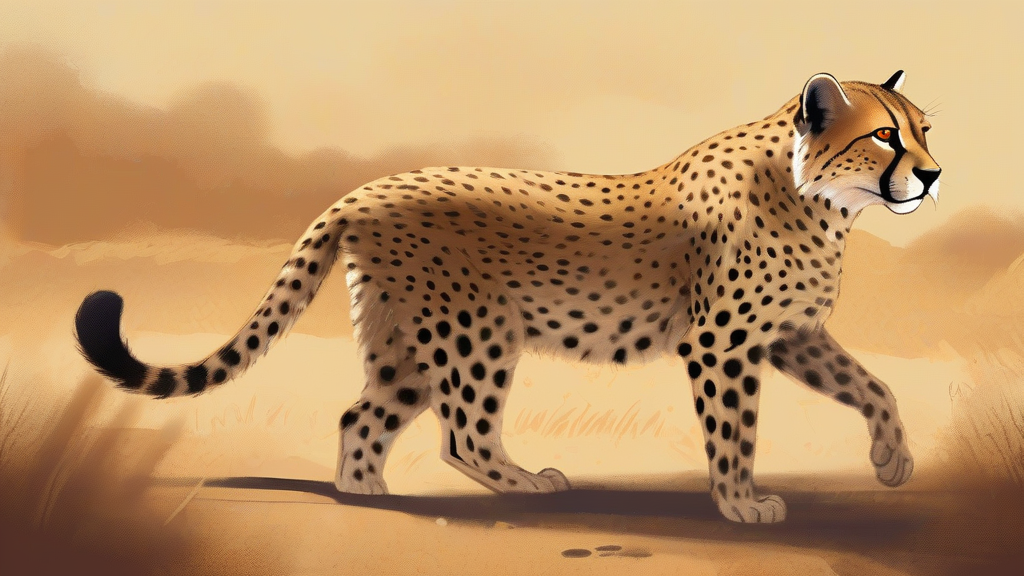
What does chetah mean?
"Chetah" is a historical variant spelling of "cheetah", the name of Acinonyx jubatus, the long-legged spotted cat renowned as the fastest land animal, capable of sprint bursts approaching 100 kilometres per hour. Native to Africa with a small remnant population in Iran, the cheetah was famously used by royalty in India and Persia as a trained hunting animal, which is how the word entered European languages from Hindi "cītā", ultimately deriving from Sanskrit roots meaning "speckled" or "variegated". The spelling "chetah" appears frequently in naturalists' writings, travelogues, and zoological texts of the 18th and 19th centuries, but it gradually gave way to "cheetah", which is now the sole standard form in both British and American English. Readers today will mostly meet "chetah" in older books, archival documents, or period illustrations. Unless quoting such sources verbatim, modern writers should always prefer "cheetah"; using "chetah" unquoted would be regarded as an error rather than an accepted alternative.
nounAn obsolete or nonstandard variant spelling of "cheetah": a large swift-running spotted cat (Acinonyx jubatus) native to Africa and parts of Asia, famed as the fastest land animal.
- A variant (now chiefly historical) spelling of "cheetah", the fastest land mammal — a long-legged spotted cat native to Africa and Iran.
"The old naturalist's journal described a chetah stalking antelope across the Indian plain."
"The colonial-era text referred to the trained hunting cat as a chetah."
"Collectors of old wildlife prints often encounter the animal labelled "chetah" rather than "cheetah"."
Pluralizes regularly with -s, like its standard form "cheetahs".
"Early accounts describe several chetahs kept in the royal menagerie."
"Chetah" is simply the cheetah under one of its old disguises — an 18th- and 19th-century spelling that survived in naturalists' accounts before "cheetah" won out.
Reviewed by Deb Chak, Editor. AI-assisted content curated by RJS Tech Solutions LLP.
Etymology of chetah
The word comes ultimately from Hindi "cītā", meaning the spotted hunting cat, which traces back through Sanskrit "citraka" ("leopard, spotted one") to "citra" ("bright, speckled, variegated"). It entered English during the 17th century, when British observers in India encountered the cats used for coursing game at court. Early English renderings varied considerably, and "chetah" became one of the established spellings through much of the 18th and 19th centuries before "cheetah" prevailed. A Sanskrit cousin of the same "spotted" root survives in "chital", the name of India's spotted axis deer.
How chetah is actually used
"Chetah" is today considered archaic or a misspelling; writers should use "cheetah" except when quoting historical sources, where the variant spelling is common in works from the 18th and 19th centuries.
Easily confused with chetah
"Cheetah" is the standard modern spelling of the animal; "chetah" is an older or variant spelling that has largely fallen out of use.
A leopard is stockier with rosette-shaped spots and climbs trees habitually, whereas the chetah (cheetah) is lankier, has solid round spots, black tear-mark stripes on its face, and is built for speed rather than climbing.