
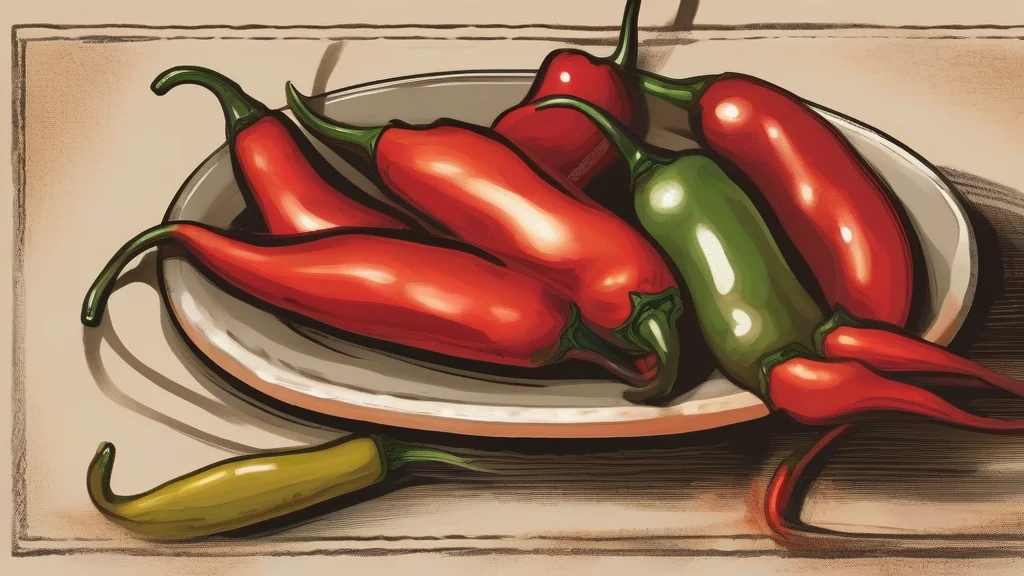
What does chilli mean?
Chilli is the British spelling of the noun denoting the pungent, pod-like fruit of plants of the genus Capsicum, prized across world cuisines for its fiery heat. Chillies may be eaten fresh, dried, ground into powder, or infused into sauces, ranging from mild varieties to fiercely hot ones whose bite comes from the compound capsaicin. In everyday British usage the word also extends to dishes built around the pepper, most famously chilli con carne, whereas American English typically uses the spelling "chili" for the same meanings. The word entered European languages from Nahuatl, the language of the Aztecs, following Spanish contact with Mexico in the sixteenth century, and has since spread into countless languages alongside the crop itself. Figuratively, chilli evokes heat, energy and boldness, appearing constantly in food writing, menus and recipes. Its near-homophone "chilly", meaning cold, makes for a memorable contrast between two words that could hardly differ more in meaning.
nounA hot-tasting pod-like fruit of plants of the genus Capsicum, used as a vegetable or spice; also (chiefly British) a dish made with such peppers.
- The pungent fruit (pod) of any of several varieties of Capsicum, eaten fresh or dried as a spice or vegetable.
- (Chiefly British, informal) A dish made with chillies and meat or beans, as in "chilli con carne".
"She added a finely chopped red chilli to the sizzling pan of onions and garlic."
"Crush two dried chillies into the oil for a gentle background heat."
"On a cold night there's nothing better than a bowl of steaming chilli con carne."
British English prefers "chillies"; American English uses "chilis" or, especially in the Southwest, "chiles".
"The market stall was piled high with red and green chillies of every heat level."
The word chilli comes from Nahuatl, the language of the Aztecs — making it one of the oldest food words the Americas gave to the world.
Reviewed by Deb Chak, Editor. AI-assisted content curated by RJS Tech Solutions LLP.
Etymology of chilli
The word chilli derives from the Nahuatl word "chīlli", the term used by the Aztecs for the Capsicum pepper. Spanish adopted it as "chile" during the colonial period in Mexico, and from Spanish it passed into English, first attested in the seventeenth century. The variant spellings "chilli" and "chili" reflect different paths of adoption into British and American English respectively.
Related word forms
How chilli is actually used
Spelling varies regionally: "chilli" is standard in Britain, Australia and India; "chili" dominates in the US, where it also commonly refers to the stew-like dish. The plural is usually "chillies" in British English and "chilis" or "chiles" in American English. The word carries connotations of heat and intensity, both literal and figurative.
Easily confused with chilli
"Chilly" is an adjective meaning uncomfortably cold, whereas "chilli" is a noun referring to the hot Capsicum pepper — they differ by one letter but are unrelated in meaning.
"Chili" is simply the American spelling of the same word, while "chilli" is the standard British spelling; "chile" is a third variant used especially in the American Southwest.