What does chimpanzee mean?
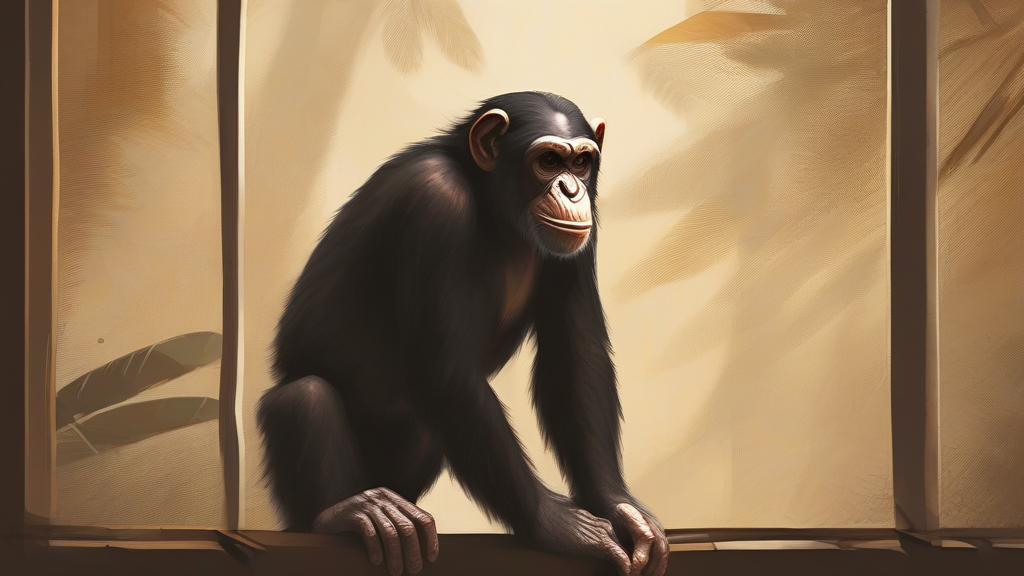
A chimpanzee is a great ape belonging to the genus Pan, native to the forests and savannas of central and western Africa. Covered in dark hair, with long arms, opposable thumbs, and prominent ears, chimpanzees are among the most intelligent animals on Earth: they make and use tools, hunt cooperatively, display complex emotions, and maintain rich social lives within troops that can number several dozen individuals. Along with the bonobo, they are humans' closest living relatives, sharing roughly 98–99% of our DNA, which has made them a central subject of primatology since Jane Goodall's landmark field studies at Gombe beginning in 1960. In everyday English, the word often appears in its shortened form 'chimp', while scientific usage reserves 'chimpanzee' for Pan troglodytes specifically. The word carries connotations of intelligence and kinship with humanity, making it a staple of both scientific literature and popular culture.
nounA great ape native to the forests of central and western Africa, with black hair, long arms, and prominent ears, closely related to humans; also called the common chimpanzee (Pan troglodytes).
- The great ape Pan troglodytes of central and western Africa, noted for its intelligence, tool use, and close genetic relationship to humans.
"The researchers spent years observing a single chimpanzee troop in Gombe National Park."
"A young chimpanzee used a stripped twig to fish termites out of the mound."
"The documentary follows a rescued chimpanzee as it learns to live among others at the sanctuary."
Standard plural, formed by adding -es. The collective noun for a group is a 'troop' or 'community' of chimpanzees.
"Wild chimpanzees can live for over fifty years."
Chimpanzees are our closest living relatives — we share roughly 98–99% of our DNA with them.
Reviewed by Deb Chak, Editor. AI-assisted content curated by RJS Tech Solutions LLP.
Etymology of chimpanzee
The word 'chimpanzee' entered English in the early 18th century, borrowed from French 'chimpanzé', which itself derives from a Bantu language of the Congo region — commonly cited as Vili or Kikongo, where a similar term referred to a man-like ape. It first appeared in English print around 1738, when accounts of an ape exhibited in London popularized the term. Its ultimate roots lie in African rather than classical European languages, making it unusual among English animal names.
How chimpanzee is actually used
The informal short form 'chimp' is common in everyday speech and journalism. In scientific writing, 'chimpanzee' typically refers specifically to the common chimpanzee (Pan troglodytes), distinguished from the bonobo. The plural 'chimpanzees' is preferred over the older collective 'chimpanzee'.
Easily confused with chimpanzee
A bonobo (Pan paniscus) is a separate, closely related species found south of the Congo River, known for its slimmer build and more peaceful social behavior, whereas the chimpanzee is Pan troglodytes.