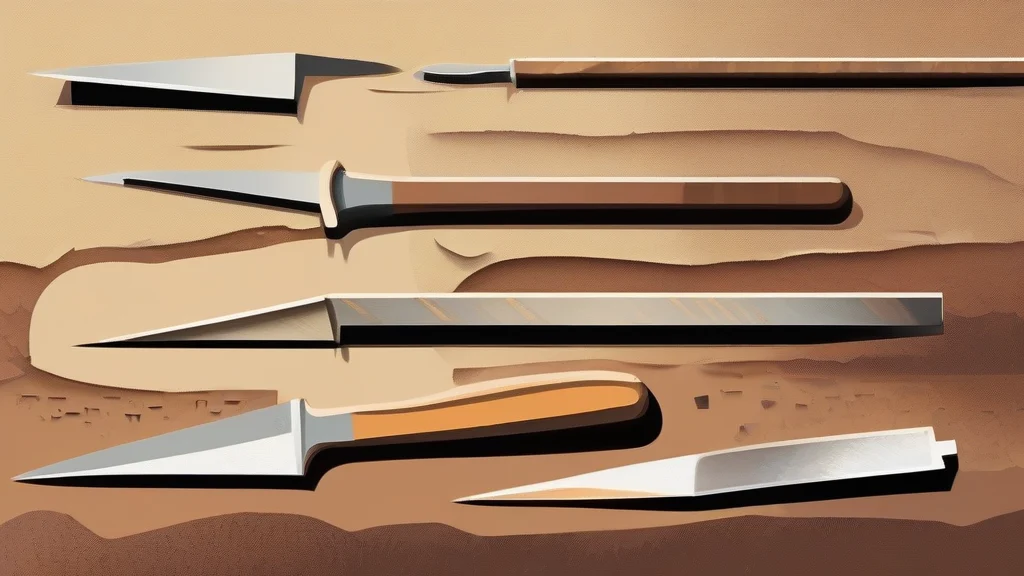
What does chisel mean?
A chisel is a hand tool consisting of a shaped metal blade with a sharpened cutting edge at one end, driven by hand pressure, a mallet, or a hammer to carve, cut, or shape hard materials such as wood, stone, or metal. Chisels vary widely in form — from fine woodworking chisels to heavy cold chisels used on metal — and are among the oldest known tools, essential to carpentry, sculpture, and masonry. As a verb, to chisel means to cut or carve with this tool, often implying patient, deliberate removal of material, as in chiselling an inscription into granite. In informal North American English, chisel also carries a negative sense meaning to cheat or swindle someone out of money. The word derives ultimately from the Latin caedere, meaning to cut, making it a relative of incise and concise. Its enduring presence in both craft vocabulary and figurative speech makes it a versatile and vivid English word.
A hand tool with a shaped cutting edge on its blade, used for carving or cutting hard materials such as wood, stone, or metal.
"He selected a narrow chisel from his toolkit and began shaping the joint."
Often paired with a mallet or hammer; specific types include the cold chisel (for metal), firmer chisel, and mortise chisel.
To cut, carve, or shape something using a chisel.
"The artisan chiselled the family name into the headstone."
Regular plural; used when referring to multiple tools of this kind.
"The workshop was stocked with chisels of every width."
The word 'chisel' comes from the Latin caedere, meaning 'to cut' — the same root that gives us 'incise', 'precise', and even 'suicide'.
Reviewed by Deb Chak, Editor. AI-assisted content curated by RJS Tech Solutions LLP.
Etymology of chisel
Chisel entered English in the late Middle English period, borrowed from Old French cisel (modern French ciseau), which derived from Vulgar Latin *cisellum, a variant of Late Latin caesellum, a diminutive of caesus, the past participle of Latin caedere, meaning to cut. This same Latin root gives English words such as incise, concise, decisive, and precise. The informal sense of cheating or swindling developed later, appearing in American English by the nineteenth century.
Related word forms
How chisel is actually used
As a verb, chisel can be transitive (to chisel a design into stone) or intransitive (he chiseled away at the rock). The informal sense meaning to cheat or swindle is chiefly North American and somewhat dated but still understood. British spelling favours 'chiselled' and 'chiselling'; American spelling uses 'chiseled' and 'chiseling'.
Easily confused with chisel
Ciselure is a rare term for the art or work of chasing and engraving metal, whereas a chisel is the physical tool itself.