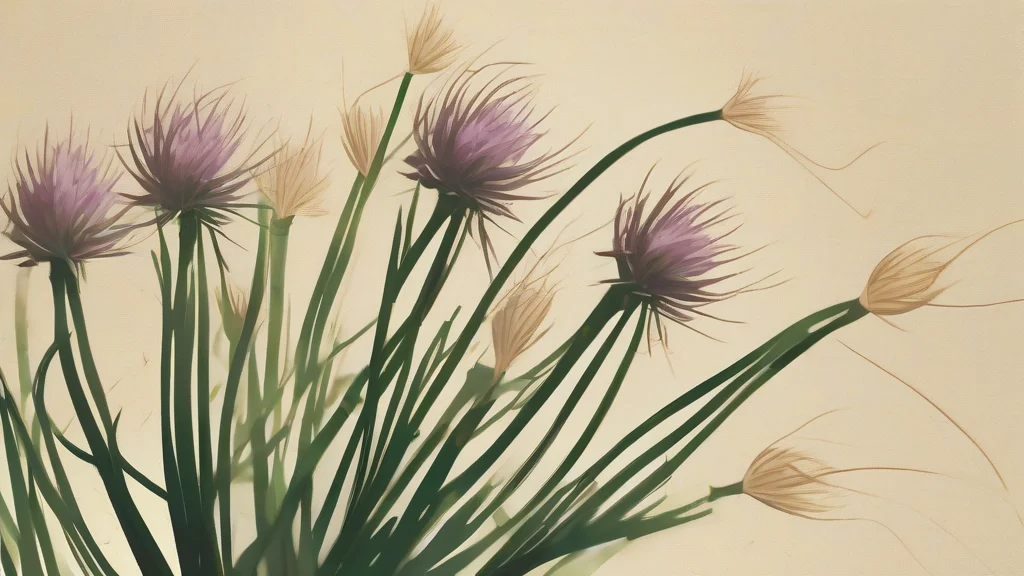
What does chive mean?
The chive (Allium schoenoprasum) is a small hardy perennial belonging to the onion family, cultivated chiefly for its long, slender, hollow green leaves. Those leaves have a mild, delicate onion flavour that makes chives one of the gentlest members of the allium clan — far subtler than garlic or a raw onion — which is why they are so often used raw or added at the end of cooking. Chopped chives are a classic garnish for baked potatoes, scrambled eggs, soups, salads, and creamy sauces such as crème fraîche, and the plant's pretty purple pompom flowers are edible as well. In the garden, chives are prized as an easy-to-grow perennial that returns year after year and even helps deter some pests. The word entered English in the early modern period from French "cive", ultimately tracing back to the Latin "cepa", meaning onion. Whether spoken of as a single plant or as the snipped herb on a plate, "chive" is a humble but indispensable word of the kitchen and garden alike.
A small bulbous perennial herb (Allium schoenoprasum) of the onion family, with narrow hollow leaves and edible purple flowers.
"The chef planted a border of chives along the edge of the herb bed."
The chopped leaves of this plant, used fresh as a mild onion-flavoured seasoning or garnish.
"Sprinkle the soup with chives and a swirl of cream before serving."
Usually treated as a mass noun in this sense and expressed in the plural form "chives".
The plural "chives" is by far the more common form, especially when referring to the herb as a culinary ingredient; the singular "chive" typically appears only when speaking of the individual plant.
"Add a tablespoon of finely chopped chives to the dressing."
Chives are the smallest member of the onion family — but their purple pom-pom flowers are edible too, and they've been flavouring dishes since at least Roman times.
Reviewed by Deb Chak, Editor. AI-assisted content curated by RJS Tech Solutions LLP.
Etymology of chive
The word "chive" came into English in the early modern period from the French "cive", which denoted the same plant. The French term ultimately derives from the Latin "cepa", meaning "onion", placing chive firmly within the linguistic family of allium vegetables. Its Romance relatives include words such as Spanish "cebolla" and Italian "cipolla", both also descendants of the Latin onion word.
How chive is actually used
"Chive" is almost always used in the plural ("chives") when referring to the herb as an ingredient; the singular tends to appear when discussing the individual plant. The word carries no strong register — it is equally at home in recipes, gardening guides, and everyday conversation.
Easily confused with chive
"Chives" is simply the usual plural form of "chive" and is the form most often used for the herb in cooking; there is no separate meaning.