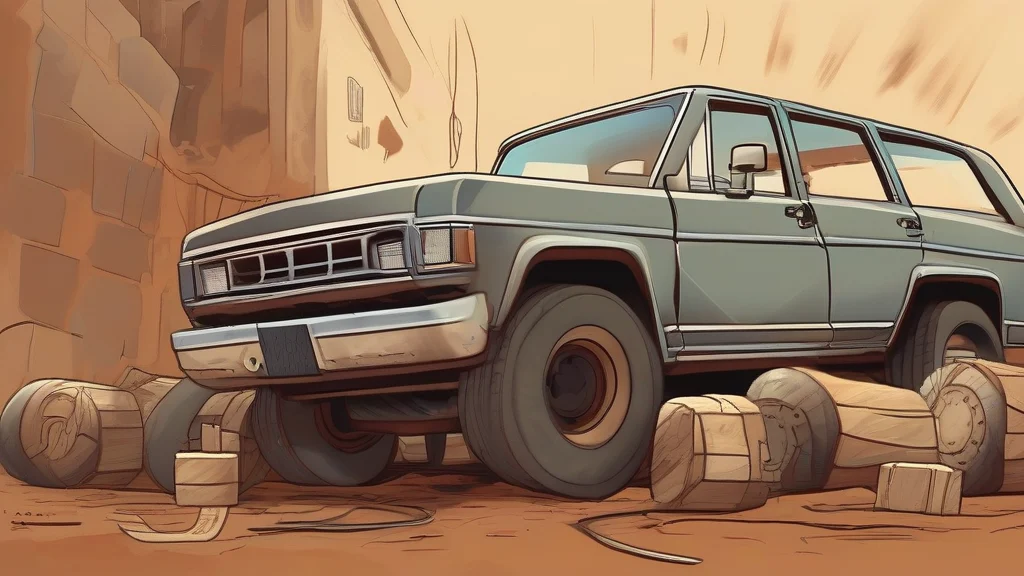
What does chocking mean?
Chocking is the present participle of the verb 'to chock', meaning to secure an object — most commonly a vehicle's wheels — by placing a wedge-shaped block, called a chock, firmly against it. The practice is essential wherever vehicles or heavy loads must be held stationary on a gradient or unstable surface: ground crews chock aeroplane landing gear, dockworkers chock cargo, and drivers chock caravans and lorries before working beneath them. The word carries a practical, technical register and appears chiefly in aviation, maritime, rail, and haulage contexts, though anyone parking a trailer on a slope may do it without naming it. Its single-letter neighbour 'choking', meaning to struggle for breath, makes careful spelling genuinely important, particularly in safety instructions where a typo could cause real confusion about whether a hazard is being prevented or created.
verb (present participle of 'chock')The act of securing an object, especially a vehicle's wheels, by placing a wedge or block (a chock) against it to prevent movement.
- Securing a wheel or object in place by driving a wedge or block against it, especially to prevent a vehicle from rolling.
- Filling or packing a space tightly (less common, as in 'chocked full').
"Before inspecting the lorry's brakes, the mechanic was chocking the rear wheels with heavy wooden blocks."
"The ground crew was chocking the aircraft's landing gear before passengers began boarding."
"He spent the afternoon chocking the barrels so they wouldn't shift during the crossing."
One letter stands between a truck rolling downhill and a driver gasping for air — which is why mechanics never misspell 'chocking' twice.
Reviewed by Deb Chak, Editor. AI-assisted content curated by RJS Tech Solutions LLP.
Etymology of chocking
The noun 'chock', a wedge or block used to steady or stop movement, appeared in English in the seventeenth century, though its ultimate origin is uncertain; suggestions include an Old French source, but etymologists have not settled the question. The verb followed naturally, meaning to secure or support something with such a block, and 'chocking' is simply its present participle. A related expression, 'chock-a-block', meaning crammed completely full, arose in nautical usage and shows how the word extended figuratively from wedging objects to filling spaces tight.
Related word forms
How chocking is actually used
A technical, practical term most often heard in aviation, shipping, haulage, and railway contexts rather than everyday conversation. It is almost always used with reference to vehicles or heavy loads at rest.
Easily confused with chocking
'Choking' means struggling to breathe because of an obstruction in the throat, while 'chocking' means securing something in place with a wedge or block.