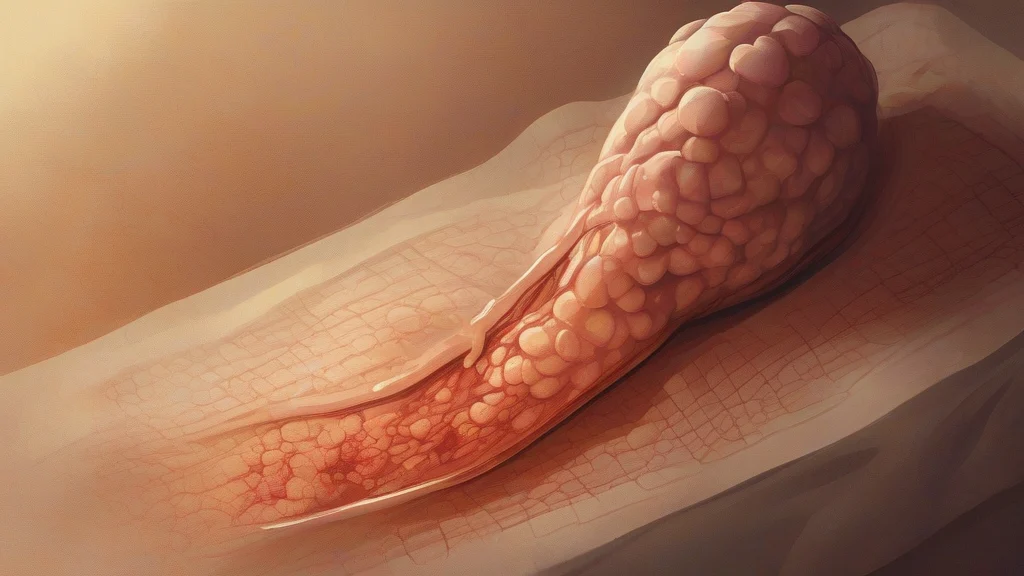
What does choriocarcinoma mean?
Choriocarcinoma is a rare but highly aggressive cancer arising from trophoblastic tissue — the specialised cells that normally form part of the placenta during pregnancy. Most cases are gestational, developing after a hydatidiform mole, a miscarriage, or a normal delivery, while others arise in the testes or ovaries as part of certain germ-cell tumours. The tumour is notorious for its rapid growth and early spread through the bloodstream, particularly to the lungs, brain, and liver, yet it also produces abundant human chorionic gonadotropin (hCG), which makes it unusually easy to detect and monitor through blood tests. This same sensitivity underpins one of modern oncology's great success stories: even advanced choriocarcinoma frequently responds completely to chemotherapy. The word belongs to formal medical vocabulary, appearing in pathology reports, oncology texts, and clinical discussion rather than everyday conversation.
nounA rare, highly malignant cancer that arises from trophoblastic tissue, most commonly developing from a hydatidiform mole or placental tissue during pregnancy, and occurring occasionally in the testis or ovary.
- A malignant tumour derived from trophoblast (the outer layer of embryonic cells), occurring in gestational tissue or, less commonly, in the testes or ovaries.
"Following evacuation of the molar pregnancy, serial hCG measurements revealed a rising titre consistent with choriocarcinoma."
"The pathology report confirmed choriocarcinoma, and the oncologist began chemotherapy within the week."
"Because choriocarcinoma secretes human chorionic gonadotropin, a simple pregnancy test can serve as both a diagnostic tool and a way to track treatment."
The anglicised plural 'choriocarcinomas' is standard in modern medical writing; the Latin-style 'choriocarcinomata' appears occasionally in older or more formal texts.
"The registry documented several choriocarcinomas diagnosed in the region over the past decade."
It's one of the few cancers named for the cells it betrays — the very tissue that nourishes an embryo can turn into one of medicine's fastest-spreading tumours, yet it often cures completely with chemotherapy alone.
Reviewed by Deb Chak, Editor. AI-assisted content curated by RJS Tech Solutions LLP.
Etymology of choriocarcinoma
The term combines three elements of New Latin medical coinage drawn from Greek: 'chorio-', from Greek khōrion (the membrane surrounding the foetus), 'carcino-', from Greek karkinos (crab, later applied to cancers), and the suffix '-oma', denoting a tumour. It was coined in the late nineteenth century as pathological understanding of gestational tumours developed. Its components connect it to a family of medical terms such as chorion, chorionic, carcinoma, sarcoma, and other '-oma' tumour names.
How choriocarcinoma is actually used
Strictly a medical term used in oncology, obstetrics, and pathology; it carries no informal register and appears almost exclusively in clinical, academic, or health-literature contexts.
Easily confused with choriocarcinoma
A hydatidiform mole is a non-cancerous (benign) abnormal pregnancy of placental tissue, whereas choriocarcinoma is the malignant cancer that may develop from it.