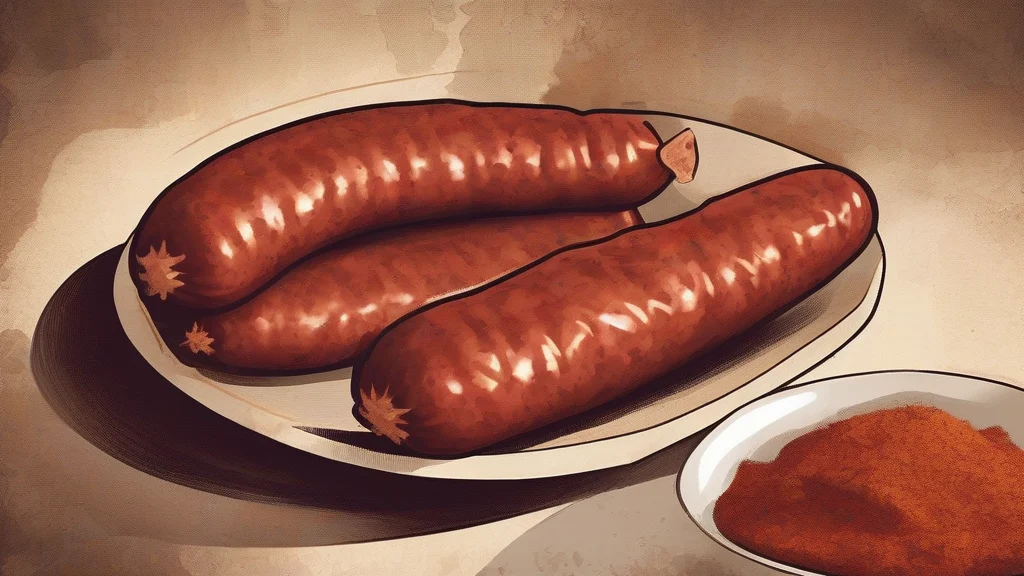
What does chorizo mean?
Chorizo is a strongly flavoured pork sausage of Spanish origin, distinguished above all by its seasoning with pimentón — smoked paprika — along with garlic and other spices, which gives both the sausage and any dish cooked with it a characteristic deep-red colour and smoky aroma. In Spain, chorizo is often cured and eaten cold, sliced like salami or served with cheese and bread, though cooking varieties also exist. In Mexico and parts of Latin America, chorizo is typically sold raw as loose minced meat meant to be fried. In English-speaking kitchens the word has become thoroughly domesticated, appearing on menus and in recipes for tapas, paella, stews, breakfasts, and pasta dishes, where a little chorizo is prized for the flavourful fat it releases. The word comes from Spanish, entering English in the nineteenth century alongside growing interest in Spanish cuisine. Its plural is commonly 'chorizos', though the uninflected form also occurs.
nounA spicy pork sausage of Spanish origin, typically seasoned with smoked paprika and garlic and cured or cooked.
- A spicy Spanish pork sausage seasoned with smoked paprika and garlic, sold cured (to eat sliced) or fresh/cooking (to fry and add to dishes)
- By extension, similar seasoned sausages made elsewhere, such as Mexican fresh chorizo
"She sliced the chorizo into coins and fried them until the paprika oil turned the whole pan red."
"He stirred crumbled chorizo through the scrambled eggs for a smoky kick."
"The tapas board came piled with manchego, olives, and thinly sliced chorizo."
'Chorizos' is the standard English plural; the unchanged form 'chorizo' also appears, reflecting Spanish usage.
"The grill was loaded with chorizos for the barbecue."
Chorizo doesn't need added fat in a pan — one link releases enough vivid red paprika oil to season an entire dish.
Reviewed by Deb Chak, Editor. AI-assisted content curated by RJS Tech Solutions LLP.
Etymology of chorizo
Chorizo was borrowed directly from Spanish in the early nineteenth century, as interest in Spanish food reached Britain and America. The Spanish word's ultimate origin is uncertain, though it has long been associated with Latin terms relating to salted or seasoned meat — the same root that gives us words such as 'sauce' and 'sausage'. Its modern identity is inseparable from pimentón, the smoked paprika brought to Spain from the Americas in the sixteenth century.
How chorizo is actually used
In English, 'a chorizo' can mean both a single sausage and, informally, an amount of it ('add some chorizo'). Plural usage varies between 'chorizos' and unchanged 'chorizo'; 'chorizos' is standard in most dictionaries. Spanish and Mexican chorizos differ significantly: Spanish versions are typically cured and paprika-heavy, while Mexican versions are usually fresh, loose-ground, and vinegar-based.
Easily confused with chorizo
A churro is a deep-fried pastry dusted with sugar, whereas a chorizo is a spicy pork sausage.
Chouriço is the Portuguese counterpart sausage, milder and often less heavily reliant on smoked paprika than Spanish chorizo.