What does chott mean?
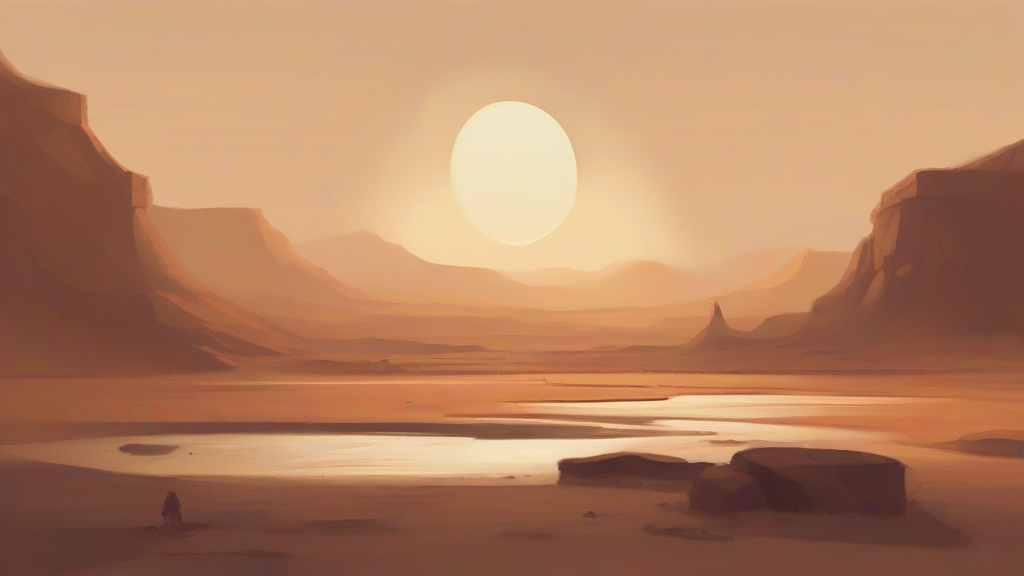
A chott is a broad, low-lying salt flat in North Africa, formed where an intermittent lake periodically fills with water during the rainy season and then evaporates under the desert sun, leaving behind a glistening crust of salt and other minerals. The term is used chiefly by geographers and travel writers describing the Sahara's great depressions, particularly the Chott el Djerid in Tunisia and the Chott Melrhir in Algeria, both of which rank among the largest such features in the world. Though bone-dry and seemingly lifeless for much of the year, chotts can briefly come alive after winter rains, attracting migrating birds such as flamingos to their shallow waters. The word entered English through French from an Arabic source, and it sits alongside related terms like 'sabkha' and 'playa' in the vocabulary of arid-land landforms. Its stark, otherworldly appearance has even made it a stand-in for alien landscapes in film.
nounA chott is a large salt flat or salt marsh in North Africa, typically the bed of an intermittent lake that floods seasonally and dries into a crust of salt.
- A salt flat or salt marsh in North Africa, being the dried or seasonally flooded bed of an intermittent lake.
"The caravan skirted the edge of the chott, where a shimmering white crust stretched to the horizon."
"After the winter rains, the chott briefly filled with water, drawing flocks of flamingos to its shallow margins."
"Geographers distinguish the larger chotts of Tunisia and Algeria from the smaller sabkhas along the coast."
The regular plural 'chotts' is standard when referring to more than one such feature.
"The great chotts of the Algerian Sahara form a chain of saline basins across the plateau."
Tunisia's Chott el Djerid is so vast and blindingly white that filmmakers used it to stand in for the desert planet Tatooine in Star Wars.
Reviewed by Deb Chak, Editor. AI-assisted content curated by RJS Tech Solutions LLP.
Etymology of chott
The word 'chott' comes from the Arabic term for a salt flat or ephemeral lake of this kind, transmitted into European usage through French, which was widely used in colonial-era descriptions of North Africa. It was adopted into English geographical writing during the nineteenth century as explorers and surveyors mapped the Sahara's great interior basins. Related terms in other languages describe similar landforms elsewhere, such as 'sabkha' in Arabia and 'playa' in the American Southwest.
How chott is actually used
The word is a technical term used mainly in physical geography, travel writing, and descriptions of the Sahara; it is rarely encountered in everyday conversation. It most often appears with reference to specific named features such as the Chott el Djerid in Tunisia or the Chott Melrhir in Algeria.
Easily confused with chott
A sabkha is a coastal or inland saline flat found especially on the Arabian Peninsula and around the Persian Gulf, whereas a chott refers specifically to the great seasonal salt lakes and flats of North Africa's Saharan region.