What does chromatin mean?
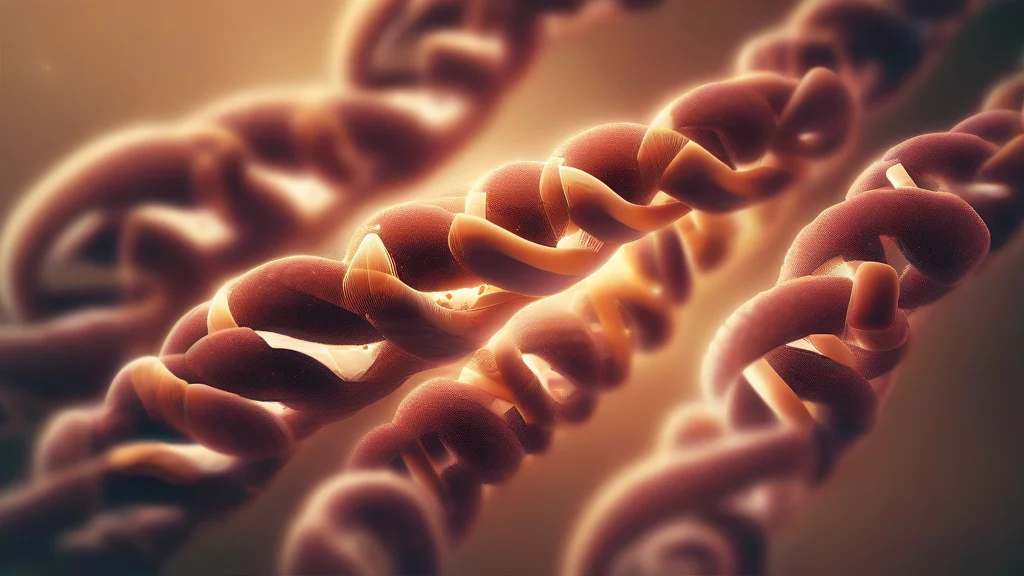
Chromatin is the material that makes up the chromosomes of living cells. Found in the nucleus of every eukaryotic cell, it consists of long strands of DNA wrapped around proteins called histones, together forming a compact, organized package. This arrangement matters enormously: by winding more or less tightly, chromatin controls which genes are accessible and can therefore be switched on or off — a key mechanism of gene regulation and epigenetics. When a cell prepares to divide, its diffuse chromatin condenses into the distinct, rod-shaped bodies known as chromosomes, ensuring genetic material is copied accurately. The word derives from the Greek 'chroma', meaning color, because early scientists could see it only when cells were stained with dyes. Today chromatin is central to research in genetics, development, and disease, appearing constantly in scientific literature though rarely in everyday speech. It functions grammatically as an uncountable noun.
nounThe complex of DNA and proteins (chiefly histones) that makes up the chromosomes within the nucleus of a eukaryotic cell.
- The substance of eukaryotic chromosomes, consisting of DNA complexed with histone and other proteins, found in the cell nucleus.
"During cell division, chromatin condenses into the tightly coiled structures visible as chromosomes."
"Epigenetic changes alter how genes are expressed without modifying the underlying sequence, often by changing how tightly the chromatin is packed."
"Under the microscope, the stained nucleus revealed chromatin distributed in a granular pattern."
Chromatin is a mass noun referring to a substance, so it does not take a plural form in ordinary usage.
"The chromatin in each nucleus condenses before mitosis begins."
Stretch out all the chromatin in one human cell and it runs about six feet long — yet it packs into a nucleus far smaller than the period at the end of this sentence.
Reviewed by Deb Chak, Editor. AI-assisted content curated by RJS Tech Solutions LLP.
Etymology of chromatin
Chromatin was named in the late nineteenth century by German biologist Walther Flemming, who coined the term for the stainable substance in cell nuclei. The name combines the Greek root 'chroma' (χρῶμα), meaning color, with the chemical suffix '-in'. That same Greek root gives us related words such as chromosome, chromatic, and chromium, reflecting how nineteenth-century science repeatedly drew on the idea of color to name things revealed by new staining techniques.
How chromatin is actually used
Strictly a technical term used in molecular biology, genetics, and cytology; it is rarely encountered outside scientific writing. It is an uncountable (mass) noun.
Easily confused with chromatin
A chromosome is a distinct condensed structure of genetic material, while chromatin is the looser DNA–protein complex from which chromosomes are formed.
A chromatid is one of the two identical halves of a duplicated chromosome, whereas chromatin is the uncondensed DNA-and-protein material throughout the nucleus.