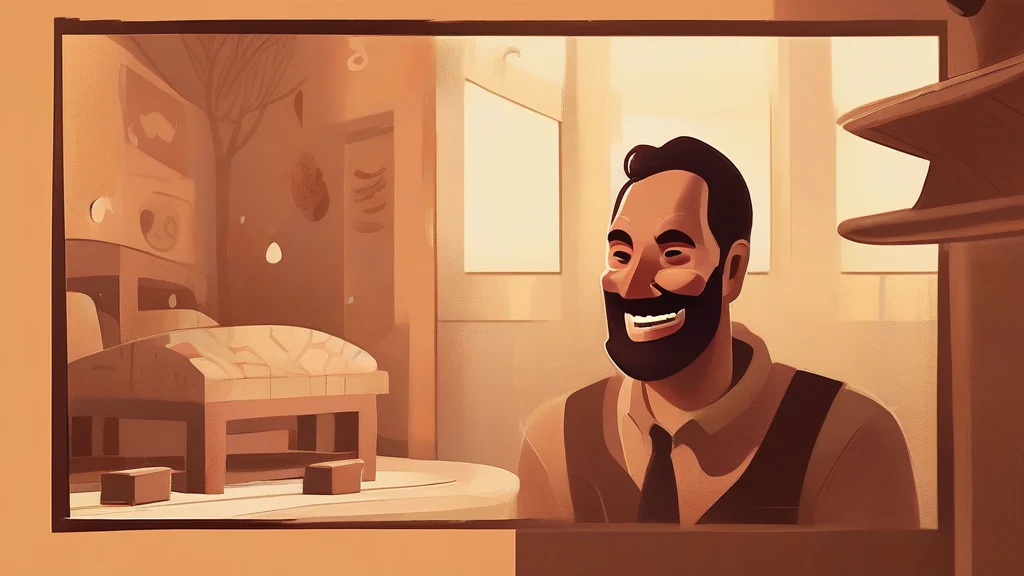
What does chuckler mean?
A chuckler is a person who chuckles: someone inclined to laugh quietly, inwardly, or in short suppressed bursts rather than out loud. The noun derives directly from the verb 'chuckle', which entered English in the sixteenth century meaning the low clucking of a hen and later came to describe soft human laughter tinged with amusement or self-satisfaction. Calling someone a chuckler suggests a reserved or understated sense of humour — the sort of reader who shakes silently over a funny novel while others guffaw. The word is informal and relatively rare, appearing mostly in descriptive or literary writing rather than everyday conversation. Its usefulness lies precisely in that specificity: where 'laughter' describes a sound and 'humour' a quality of mind, 'chuckler' names a recognisable personality type, the quiet appreciator of comedy. Related terms include 'chortle', coined by Lewis Carroll, and 'giggler', for those whose suppressed laughter runs higher-pitched.
nounA person who chuckles — that is, who laughs quietly or inwardly, often with amusement or satisfaction.
- A person who laughs quietly, softly, or to themselves.
"A quiet chuckler in the back row, he rarely laughed aloud but his shoulders always gave him away."
"An inveterate chuckler, she could read a comic essay without once breaking into an audible laugh."
"The film's director was a known chuckler on set, murmuring with amusement at his own jokes."
The standard plural follows regular English noun formation.
"The front rows were all chucklers, laughing softly at every aside."
Every chuckler owes their word to a chicken — 'chuckle' began life in the 1500s as the clucking sound a hen makes before it ever described human laughter.
Reviewed by Deb Chak, Editor. AI-assisted content curated by RJS Tech Solutions LLP.
Etymology of chuckler
'Chuckler' is formed from the verb 'chuckle' plus the agentive suffix '-er', denoting a person who performs the action. The verb itself arose in late sixteenth-century English as a frequentative of 'chuck', an imitative word for the clucking of chickens; by the seventeenth century it had shifted from describing hens to describing quiet human laughter. It therefore belongs to the same expressive family as other imitative laughter words such as 'chortle', which Lewis Carroll invented in 1871 by blending 'chuckle' and 'snort'.
How chuckler is actually used
A rare, chiefly informal derivative of the verb 'chuckle'. It carries no negative connotation; a chuckler is simply someone whose amusement tends to be subdued rather than loud. Because it is uncommon, many dictionaries list it only under its parent verb.
Easily confused with chuckler
A chortle is a joyful, chuckling laugh itself (coined by Lewis Carroll), whereas a chuckler is the person doing the chuckling.
A chuckle is the act or sound of soft laughter, while a chuckler is a person who produces it.