What does churning mean?
Churning refers to forceful, continuous agitation — most classically the vigorous stirring of cream in a churn until it turns to butter. From this domestic origin, the word broadened to describe any violent swirling motion, from storm-whipped seas to the roiling of a troubled stomach. Today it is most often encountered figuratively: a feeling of dread produces a churning in the gut, markets undergo churning as holdings are rapidly bought and sold, and businesses speak of customer churn to describe constant turnover. The word carries connotations of unrest, repetition, and sometimes distress, though it can be neutral when describing machinery or natural forces. Its enduring usefulness lies in capturing both physical turbulence and emotional turmoil with a single vivid image rooted in one of humanity's oldest food-making tasks.
The action of agitating a liquid vigorously, especially stirring cream in a churn to make butter; by extension, any violent or turbulent movement or turnover.
"The constant churning of the propellers left a white wake behind the ferry."
Present participle and gerund of churn: to stir or shake a liquid vigorously; to move violently or feel intense inner agitation.
"Her thoughts were churning as she waited for the results."
Rarely pluralized; the plural appears mainly in technical or literary descriptions of repeated acts of churning.
"The day's churnings yielded several pounds of fresh butter."
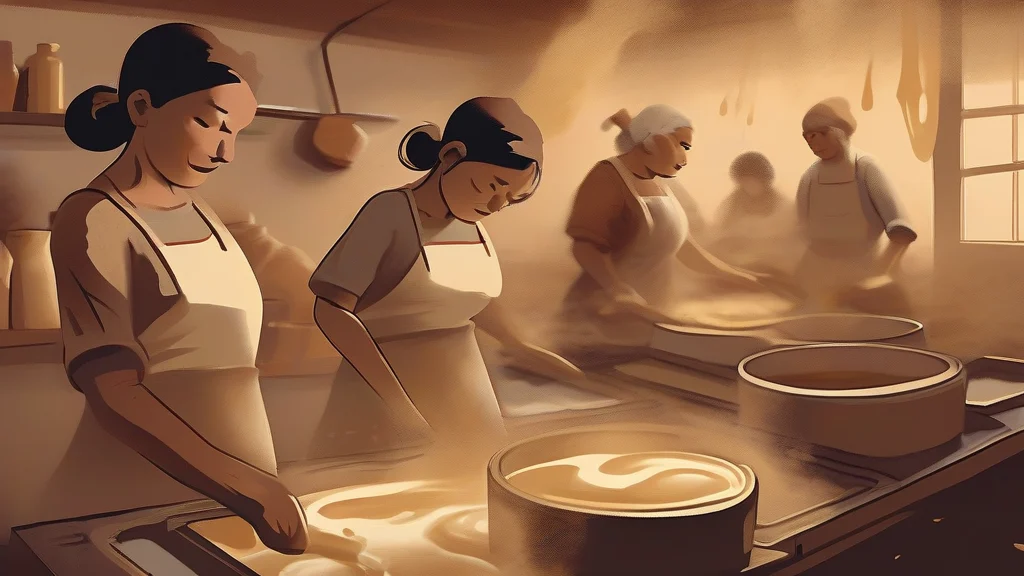
Before electric mixers, making butter meant hours of churning — so much so that 'churn' became shorthand for any exhausting, repetitive task.
Reviewed by Deb Chak, Editor. AI-assisted content curated by RJS Tech Solutions LLP.
Etymology of churning
Churning derives from churn, a noun found in Old English (as cyrin or similar forms), with related forms in other Germanic languages such as Old Norse kirna, suggesting an ancient Germanic word for the butter-making vessel. The verbal sense of agitating cream developed naturally alongside the tool, and figurative uses describing turbulent movement appeared as the verb extended beyond the dairy. Cognate forms exist across Germanic languages, but the deeper pre-Germanic origins of the word remain uncertain.
Related word forms
How churning is actually used
Most often used today in its figurative sense to describe turbulence, unease, or relentless activity; the literal dairy sense is now largely historical or rural. In business jargon, 'churn' and its derivatives carry a technical meaning about customer or employee turnover that is unrelated to butter-making.