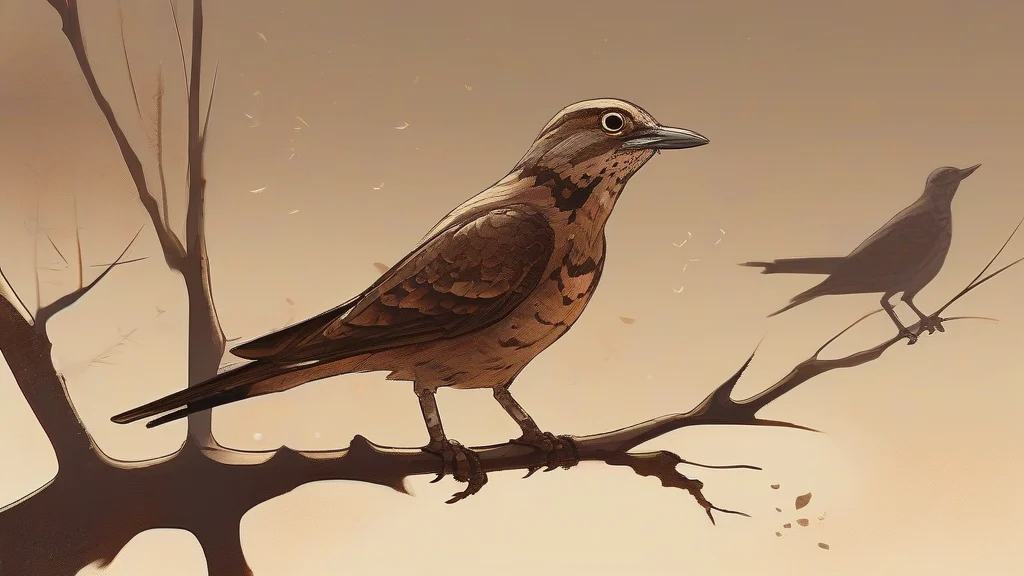
What does churr mean?
Churr is a specialized term for a low, sustained, trilling sound, most famously the call of the European nightjar. On warm summer evenings, male nightjars produce this long, mechanical-sounding vibration from perches or during song flights, and naturalists have long described it as a churr because of its resemblance to a distant motor or a deep purr. The word functions as both a noun, naming the sound itself, and a verb, describing the act of making it. It appears almost exclusively in ornithology, field guides, and nature writing, giving it a precise, descriptive register rather than an everyday one. Because the term is closely tied to a single well-known birdsong, encountering churr usually signals writing about nocturnal birds or heathland landscapes. For readers interested in British wildlife, knowing the word connects a familiar twilight sound to its proper name.
A low, continuous trilling or vibrating sound, especially the characteristic call of the European nightjar.
"We sat quietly on the heath until the churr of a nightjar broke the silence."
Primarily found in ornithological contexts and nature writing.
To produce a low, sustained trilling sound, as certain birds do.
"From the cover of the birches, the bird churred without pause for several minutes."
The plural is rare in practice, since the call is typically discussed in the singular even when multiple birds are calling.
"The churrs of several nightjars overlapped across the darkening moor."
On summer evenings in Britain, that strange mechanical buzzing you hear from the heath isn't machinery at all — it's a nightjar, and ornithologists literally call it a churr.
Reviewed by Deb Chak, Editor. AI-assisted content curated by RJS Tech Solutions LLP.
Etymology of churr
Churr is generally regarded as an imitative word, coined to mimic the actual sound of the nightjar's call rather than derived from another language. It emerged in English natural-history writing, likely in the eighteenth or nineteenth century, when field naturalists sought precise terms for bird vocalizations. Because of its imitative origin, it has no true cognates in other languages, though similar echoic formations exist for comparable sounds.
Related word forms
How churr is actually used
The word is chiefly used in ornithological and nature-writing contexts, where it is the established term for the European nightjar's distinctive call. It is uncommon in everyday speech and carries no figurative or emotional connotations. Both noun and verb forms appear, though the noun is the more frequent usage.
Easily confused with churr
"Chirr" refers to a similar but higher-pitched insect-like trill, while "churr" denotes the deeper, more guttural call associated chiefly with birds like the nightjar.