What does cicala mean?
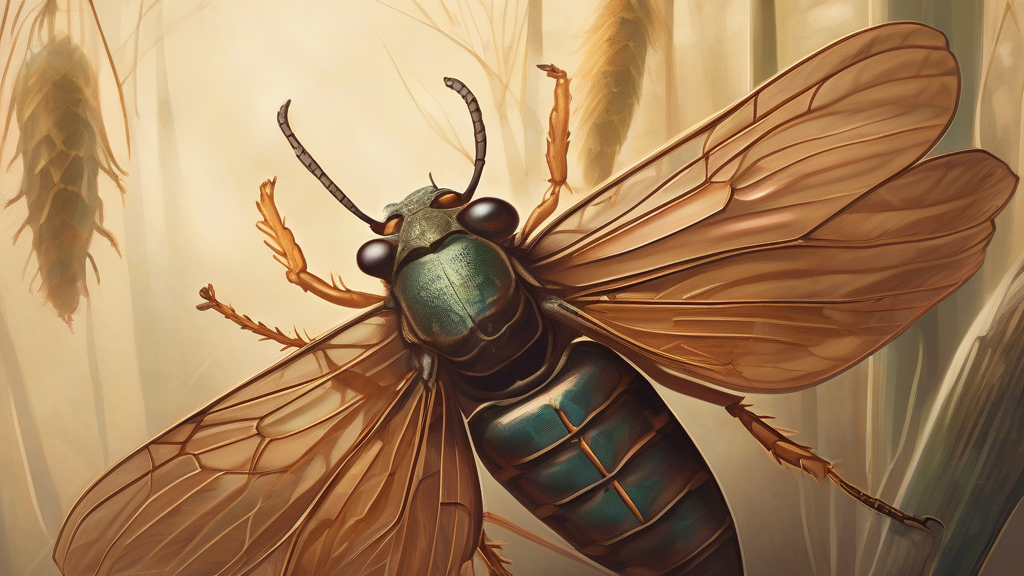
Cicala is a noun meaning a cicada: the large, broad-headed insect with transparent, prominently veined wings whose males produce a loud, monotonous droning or chirping song, most famously during hot summers in southern Europe and other warm climates. The English word is borrowed from the Italian 'cicala', itself descended from the Latin 'cicada', which also gave English its far more common term 'cicada'. Because of this, 'cicala' functions today as a literary variant rather than the standard name for the insect: it appears most often in poetry, travel writing, and descriptive prose, where its Italianate sound suits evocations of Mediterranean landscapes — olive groves, sun-baked courtyards, and drowsy afternoons filled with insect song. Writers may use either 'cicalas' or the more learned 'cicalae' as the plural, though 'cicalas' is usual. Readers encountering the word should simply understand it as 'cicada', rendered with a continental flourish.
nounA cicada; a large insect with transparent wings, the male of which makes a loud droning or chirping sound, especially in warm regions. The word is an anglicized borrowing of the Italian form of 'cicada'.
- The cicada, an insect whose male produces a loud stridulating song.
"From the olive groves came the ceaseless shimmer of the cicala, the very voice of the Mediterranean noon."
"The heat was so intense that even the cicalas seemed to falter in their song."
"He remembered the cicala's monotonous cry drifting through the shutters of his Tuscan hotel."
The regular plural 'cicalas' is standard; the Latinate 'cicalae' appears occasionally in learned or literary writing but is uncommon.
"The hillside hummed with cicalas throughout the long August afternoon."
Before 'cicada' settled into English, writers reached for the musical-sounding Italian 'cicala' to conjure the drowsy drone of a southern summer.
Reviewed by Deb Chak, Editor. AI-assisted content curated by RJS Tech Solutions LLP.
Etymology of cicala
English took 'cicala' directly from Italian 'cicala', the Italian descendant of Latin 'cicada', the classical name for the insect. The same Latin root yielded English 'cicada' and French 'cigale', making these true cognates. Borrowed into English usage around the early modern period, 'cicala' has always remained secondary to 'cicada', surviving mainly as a poetic alternative.
How cicala is actually used
'Cicala' is a literary or somewhat archaic variant of 'cicada', often retained by writers for its Italianate flavor when evoking Mediterranean settings. The standard plural is 'cicalas'; the Latinate 'cicalae' also occurs but is rare. In ordinary modern usage 'cicada' strongly predominates.
Easily confused with cicala
'Cicada' is the standard scientific and everyday English term for the same insect, while 'cicala' is a literary variant borrowed from Italian.