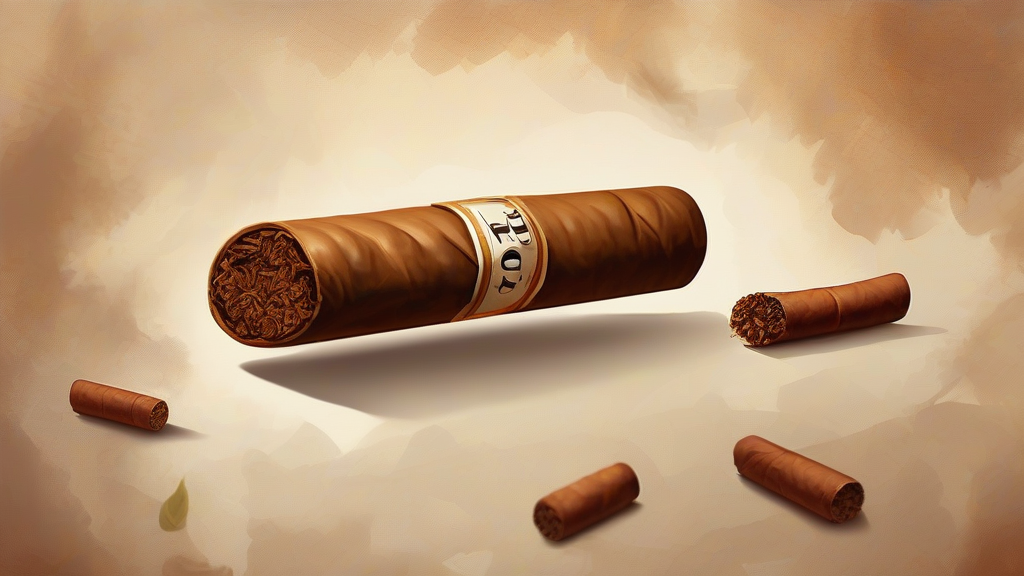
What does cigar mean?
A cigar is a tightly rolled bundle of cured and fermented tobacco leaves, wrapped in an outer leaf of tobacco, that is lit at one end and smoked for its flavor and aroma. Unlike cigarettes, cigars are generally not inhaled into the lungs; the smoke is drawn into the mouth and savored. Cigars vary widely in size, shape, and quality, ranging from inexpensive machine-made varieties to premium handmade ones aged for years, with celebrated origins in Cuba, the Dominican Republic, and Nicaragua. The word entered English in the early eighteenth century from Spanish 'cigarro,' itself probably adopted from an Indigenous Caribbean source. Culturally, the cigar carries strong connotations of celebration, leisure, wealth, and tradition — associated with weddings, victories, boardrooms, and gentlemen's clubs — which has made it both a symbol of success and a subject of health-related controversy.
nounA cylindrical roll of cured and fermented tobacco leaves wrapped in tobacco leaf, smoked for pleasure rather than inhaled like a cigarette.
- A compact roll of cured tobacco leaves wrapped in a tobacco leaf, smoked by burning one end.
"He lit a fine Cuban cigar to celebrate the birth of his daughter."
"The old gentleman settled into his armchair with a newspaper and a cigar."
"Victory cigars were handed out in the locker room after the championship game."
Regular plural; used both for physical quantities ('three cigars') and generically ('the shop sells fine cigars').
"The humidor held two dozen carefully aged cigars."
The word 'cigar' traveled into English from Spanish 'cigarro,' which likely borrowed it from an Indigenous Mayan term — making every puff a linguistic echo of the Caribbean.
Reviewed by Deb Chak, Editor. AI-assisted content curated by RJS Tech Solutions LLP.
Etymology of cigar
The English word 'cigar' was borrowed from Spanish 'cigarro' around the early eighteenth century, as tobacco smoking spread from the Americas into Europe. The Spanish term is widely believed to derive from an Indigenous Mayan or Caribbean word for smoking rolled tobacco, though scholars debate the exact source. The related word 'cigarette' is simply a French diminutive of the same Spanish root, meaning 'little cigar.'
How cigar is actually used
The word carries connotations of leisure, celebration, affluence, or old-fashioned masculinity; it is neutral in register but the activity itself is often associated with formal celebrations or gentleman's clubs.
Easily confused with cigar
A cigar is a larger roll of fermented tobacco meant to be savored without inhaling, while a cigarette is a small paper-wrapped cylinder of shredded tobacco that is typically inhaled.