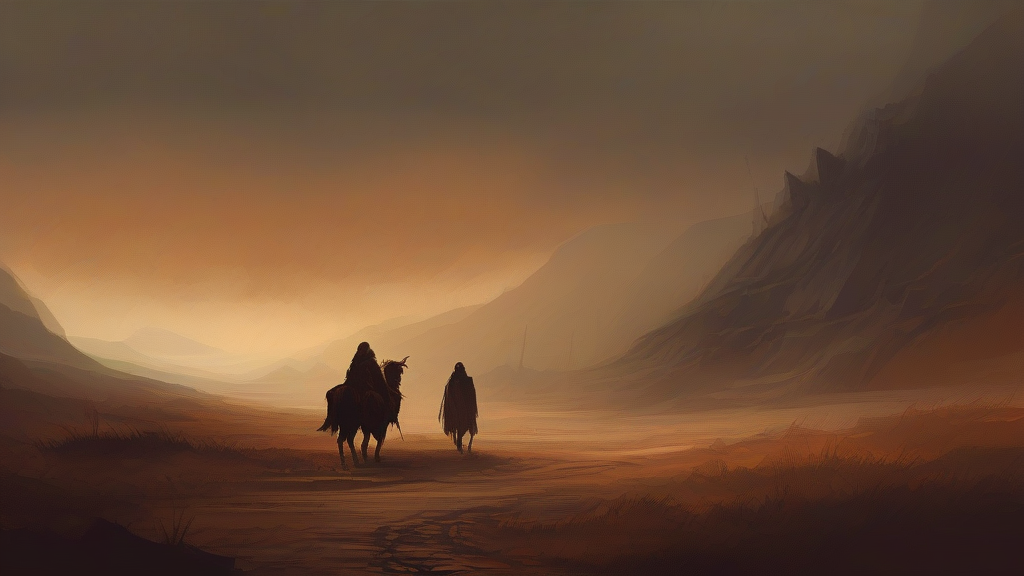
What does cimmerian mean?
"Cimmerian" means profoundly dark or gloomy — darkness so complete that it seems absolute. The word descends from the Cimmerians, a legendary people described by Homer and later classical writers as dwelling in perpetual night and mist at the far edges of the known world. In modern usage it is almost always an adjective describing oppressive, lightless places: cimmerian caverns, a cimmerian mood, cimmerian despair. It carries strong literary connotations, appearing frequently in Gothic fiction, poetry, and atmospheric prose, and its tone is typically ominous or melancholy rather than merely dim. Because it evokes mythic rather than ordinary darkness, "cimmerian" lends writing a grand, almost primordial quality that plainer words like "dark" cannot supply. A rarer capitalized form refers to the actual ancient Cimmerian people, a nomadic group of the early first millennium BCE known to Assyrian records and Greek historians such as Herodotus.
Characterized by profound, impenetrable darkness or gloom; suggestive of the perpetual night attributed to the mythical Cimmerians.
"The ship's hold was cimmerian, lit only by a single swaying lantern."
A member of the Cimmerians, an ancient nomadic people who inhabited the steppes north and east of the Black Sea and were known to Assyrian and Greek sources.
"Herodotus traces how the Scythian advance displaced the Cimmerians southward into Anatolia."
This noun sense always appears capitalized and belongs to historical writing; it is distinct from the everyday adjectival use meaning extremely dark.
In Homer's Odyssey, the Cimmerians were a people shrouded in eternal mist and never-ending night — so 'cimmerian' literally means darkness worthy of legend.
Reviewed by Deb Chak, Editor. AI-assisted content curated by RJS Tech Solutions LLP.
Etymology of cimmerian
"Cimmerian" comes from Latin Cimmerius, itself borrowed from Greek Kimmerios, referring to the Cimmerians — a real nomadic people of the region around the Black Sea whom Greek tradition transformed into a race living in eternal darkness. Homer's Odyssey already locates them in a land of unending night, and this mythic association fixed the word's meaning of utter gloom. The adjective entered English literature via classical learning, with capitalized uses denoting the historical people and lowercase uses denoting impenetrable darkness.
Related word forms
How cimmerian is actually used
Literary and somewhat elevated in register; most often encountered in descriptive prose evoking oppressive darkness. When used with a capital letter it refers specifically to the historical Cimmerian people; lowercase use describes extreme gloom.
Easily confused with cimmerian
Despite the similar spelling and sound, 'chimerical' means wildly fanciful or illusory (from the Chimera of Greek myth), while 'cimmerian' means intensely dark or gloomy.