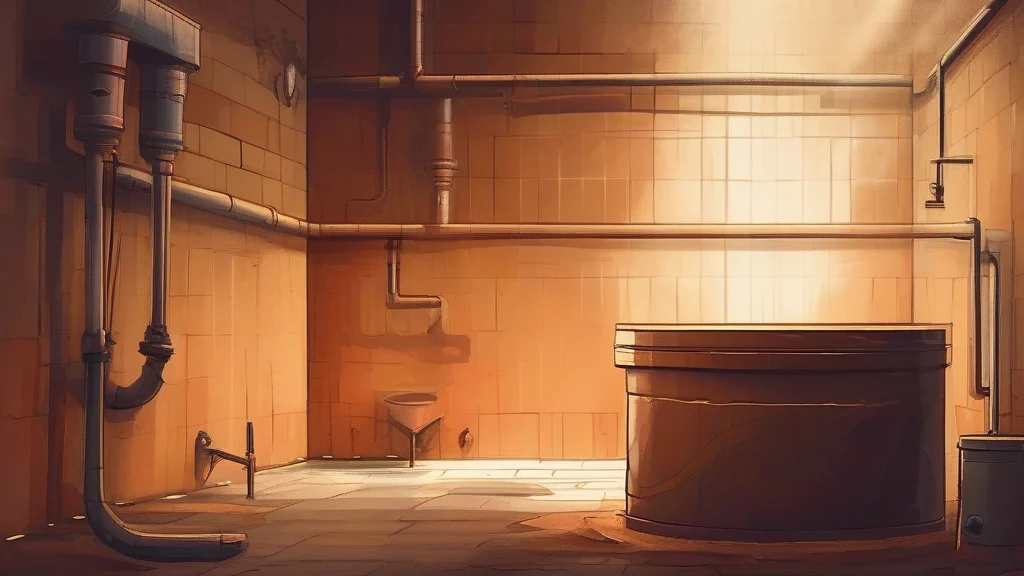
What does cistern mean?
A cistern is a container or chamber designed to hold water, most often rainwater gathered from rooftops or ground surfaces and kept in reserve for drinking, washing, or irrigation. Cisterns may be small household vessels, large covered tanks, or substantial chambers excavated in rock or masonry, and they have been vital in arid regions and fortresses where springs were unreliable or vulnerable to siege. The word carries a practical, slightly old-world connotation, evoking farmsteads, Mediterranean courtyards, and historic engineering rather than modern municipal supply. In British plumbing vocabulary, "cistern" has a second, everyday life as the name of the tank that stores flush water in a toilet — a sense many American speakers know only as the "tank". Whether describing an ancient subterranean reservoir or the box behind a lavatory, the word consistently refers to stored water held ready for use.
nounA cistern is a tank or reservoir, typically built to store rainwater or other water for later use; in British plumbing usage, it also refers to the water-storage tank of a toilet.
- A container or underground chamber for storing water, especially rainwater collected from roofs or ground runoff.
- (British English) The tank above or behind a toilet that holds water for flushing.
"The farmhouse drew its drinking water from a stone cistern beneath the courtyard."
"During the drought, the village relied entirely on the ancient cistern cut into the hillside."
"He lifted the lid of the cistern and adjusted the float valve to stop the constant running."
Standard regular plural; used when referring to multiple storage tanks or chambers.
"The fortress was supplied by three vast cisterns carved into the rock below."
Ancient Roman engineers built cisterns so vast that some still hold water two thousand years later.
Reviewed by Deb Chak, Editor. AI-assisted content curated by RJS Tech Solutions LLP.
Etymology of cistern
Cistern entered English in the Middle Ages via Old French "cisterne", from Latin "cisterna", meaning an underground water tank, itself derived from "cista", a wicker box or chest borrowed from Greek "kístē". Because the same Greek root gave Latin words such as "cista", English cognates connected with boxes and cutting include "chest" (via Germanic borrowing) and terms formed on the Latin verb "caedere", to cut, such as "scissors" and "incise". The word's long history reflects how central stored water was to ancient urban life, from Roman cisterns to medieval castle wells.
How cistern is actually used
In British English, "cistern" commonly refers specifically to the flush tank of a toilet, a use less familiar to American speakers, who typically say "tank". In technical and historical contexts it denotes any constructed water-storage vessel, often underground.
Easily confused with cistern
"Sister" is a female sibling, while "cistern" is a water-storage tank — they sound similar but share nothing but sound.
A reservoir is usually a large natural or artificial lake storing a public water supply, whereas a cistern is a smaller, enclosed container for stored water.