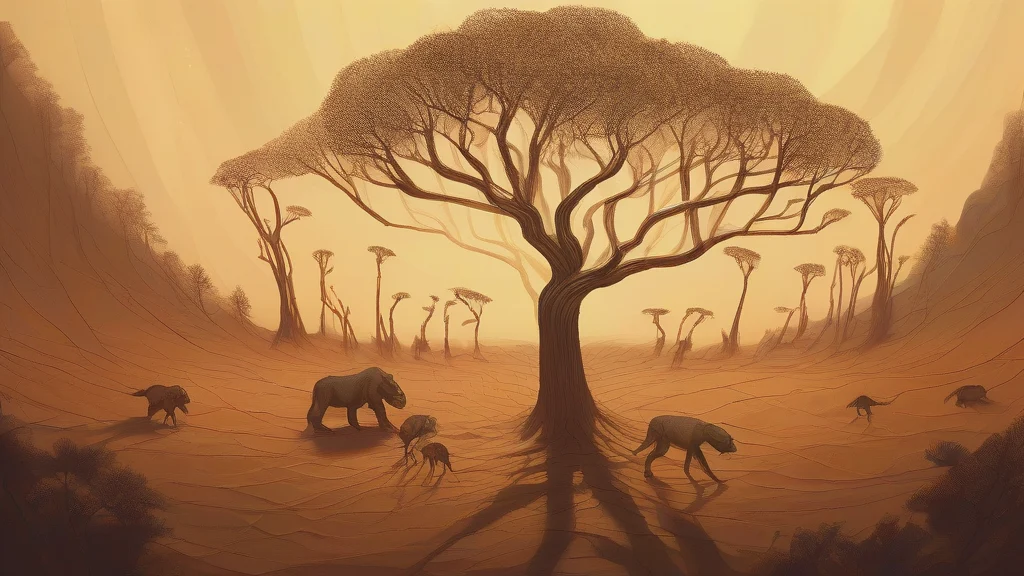
What does cladogenesis mean?
Cladogenesis is the process by which a single evolutionary lineage splits into two or more separate branches, giving rise to new species or clades that descend from a shared ancestor. Unlike anagenesis, in which one lineage gradually transforms into another without dividing, cladogenesis is inherently a branching event — it increases biodiversity by multiplying lineages rather than replacing one form with another. The word belongs chiefly to the vocabulary of evolutionary biology and systematics, where phylogenetic trees visually record its results: every fork in such a tree represents an instance of cladogenesis. Classic examples include Darwin's finches of the Galápagos and the adaptive radiations of cichlid fish in African lakes, where repeated lineage splitting produced remarkable species diversity. For anyone studying how life's diversity came about, understanding cladogenesis is essential, since it is the fundamental mechanism behind the branched, tree-like pattern that characterizes the history of life on Earth.
nounThe evolutionary splitting of a lineage into two or more distinct branches, producing new species or clades from a common ancestor. In cladogenesis, the parent lineage diverges rather than simply transforming over time into a single descendant form.
- The splitting of an ancestral lineage into two or more distinct descendant lineages during evolution, as opposed to the unbranched transformation of a single lineage (anagenesis).
"The finches of the Galápagos are a classic case of cladogenesis, with each island population branching off to form its own species."
"Darwin's finches illustrate how cladogenesis can fill an archipelago with dozens of distinct species descended from a single colonizing ancestor."
"Phylogenetic trees are essentially diagrams of cladogenesis: each node marks a point where one lineage split into two."
Rarely needed in practice, as the term usually refers to the general phenomenon rather than to countable instances; when instances are counted, plural forms appear mainly in academic writing.
"The fossil record preserves evidence of numerous cladogeneses throughout the history of the group."
Every time one species splits into two, evolution takes a fork in the road — biologists call that moment cladogenesis, and it's how the tree of life got its shape.
Reviewed by Deb Chak, Editor. AI-assisted content curated by RJS Tech Solutions LLP.
Etymology of cladogenesis
Cladogenesis was coined in the twentieth century within evolutionary biology, drawing on Greek roots: 'klados' meaning branch or shoot, and 'genesis' meaning origin or birth. The same Greek root for branch underlies 'clade' and the adjective 'cladistic', terms central to modern classification, while 'genesis' recurs across scientific coinages such as parthenogenesis and abiogenesis. The word was formed as a deliberate counterpart to 'anagenesis' (change along a single lineage) to describe branching evolutionary change.
How cladogenesis is actually used
A technical term used almost exclusively in evolutionary biology, systematics, and related academic contexts; it is rare in everyday speech. It carries no particular connotation beyond its scientific meaning. The term contrasts explicitly with anagenesis, and this contrast is often drawn when the word appears.
Easily confused with cladogenesis
Anagenesis is the evolutionary transformation of a single lineage over time without branching, whereas cladogenesis involves the splitting of a lineage into two or more separate branches.