What does clafouti mean?
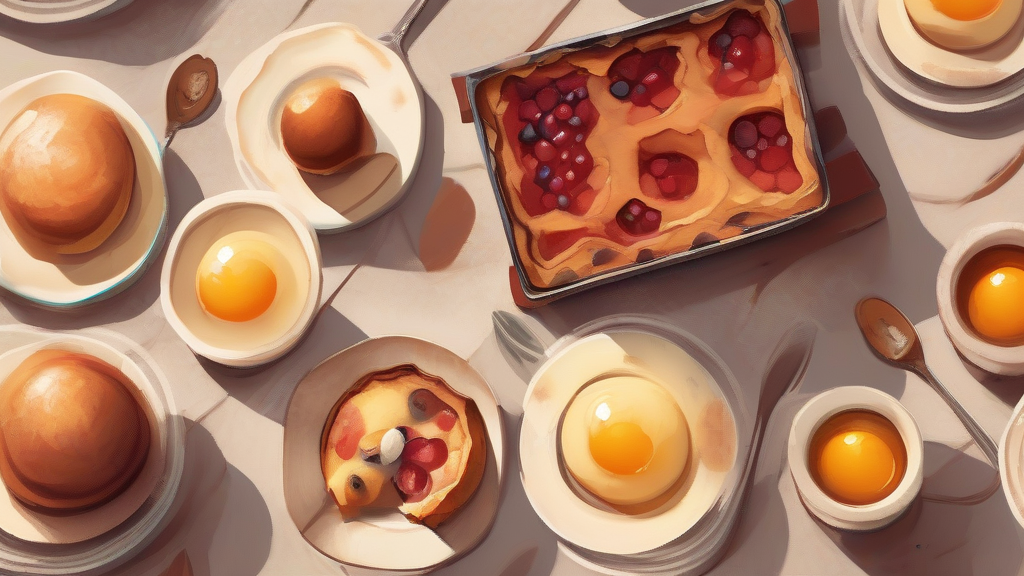
A clafouti is a classic French dessert in which fresh fruit — almost invariably black cherries — is baked beneath or within a thick, sweet batter resembling a cross between a pancake and a flan. The dish emerges from the oven puffed and golden, then settles as it cools, and it is most often served warm with a dusting of powdered sugar. Traditional recipes leave the cherry pits intact, a practice believed to deepen the flavor with subtle almond notes. The name comes from the Limousin region of France, and English has borrowed both the word and the dish, with the variant spelling 'clafoutis' commonly used for the same dessert. Rustic rather than refined, the clafouti occupies a beloved middle ground between pudding and tart: simple to make, dependent on the quality of the fruit, and elegant in its unadorned presentation. It appears frequently in cookbooks and restaurant menus devoted to French country cooking.
nounA French dessert consisting of fresh fruit, traditionally black cherries with their pits left in, baked in a thick, flan-like batter and typically served warm dusted with powdered sugar.
- A French dessert of fruit, especially unpitted black cherries, baked in a sweet pancake- or flan-like batter.
"She pulled a golden clafouti from the oven, its cherries glistening through the custardy batter."
"For Sunday lunch, her grandmother always baked a cherry clafouti studded with fruit from the garden."
"The bistro's summer menu featured a plum clafouti served warm with a spoonful of crème fraîche."
English borrows the French convention: 'clafoutis' functions as both the French singular and the standard plural. Many cooks simply use 'clafouti' or 'clafoutis' as an invariant collective noun when referring to multiple desserts informally.
"The patisserie offered two clafoutis that morning — one cherry, one apricot."
Purists insist you leave the cherry pits in the clafouti — they're said to release an almond-like flavor as it bakes.
Reviewed by Deb Chak, Editor. AI-assisted content curated by RJS Tech Solutions LLP.
Etymology of clafouti
Clafouti derives from the Limousin dialect of Occitan, specifically from 'clafir', meaning 'to fill up', which traces back to the Vulgar Latin verb formed from 'figere' ('to fasten') — the same root that gives English words like 'fix' and 'transfix'. The dessert originated in the Limousin region of central France, where it was traditionally made with unpitted black cherries. The word entered English via French cuisine, and the alternate spelling 'clafoutis' preserves the original French singular form.
How clafouti is actually used
The word is borrowed directly from French and often retains its French plural form 'clafoutis' in English, though 'clafoutis' also functions as a singular in English usage. It carries a rustic, homey connotation rather than haute-cuisine formality. Both spellings 'clafouti' and 'clafoutis' appear in English; the latter reflects the original French singular form.
Easily confused with clafouti
A flaugnarde is a closely related French batter-baked dessert made with fruits other than cherries (such as apples, pears, or plums), whereas a true clafouti is classically made only with cherries.
A crumble is topped with a crumbly streusel-like mixture of flour, butter, and sugar, while a clafouti consists of fruit suspended in a smooth, custard-like batter.