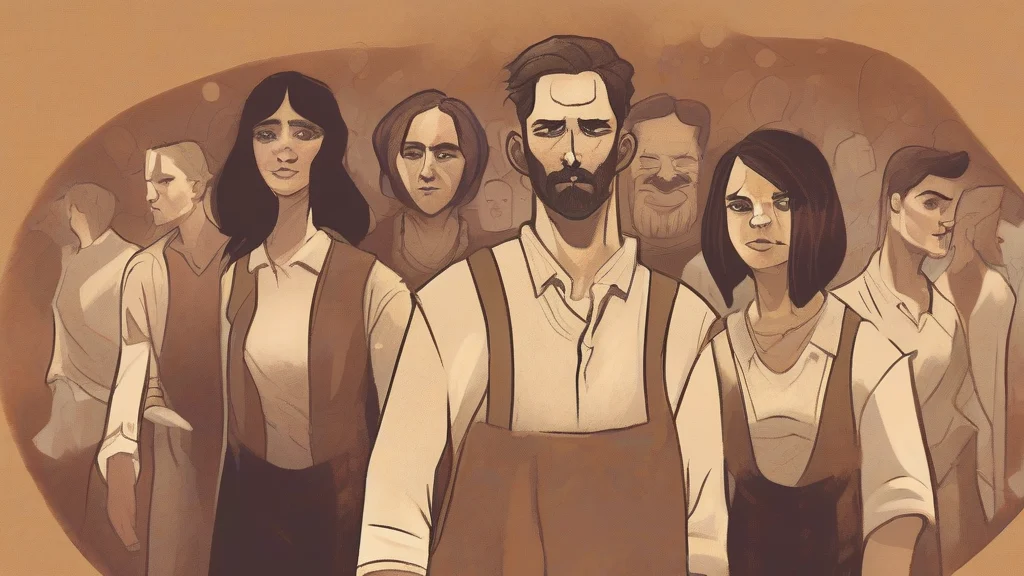
What does clannishness mean?
Clannishness is the quality of being clannish: a strong tendency among members of a group — whether a family network, an ethnic community, an institution, or a small clique — to stick together, favour one another, and keep outsiders at arm's length. The term derives from 'clan', which entered English through Scottish Gaelic 'clann', meaning offspring or descendants. In modern usage, clannishness most often appears in discussions of organisations, politics, and immigrant or rural communities, where it may be blamed for nepotism, insularity, or resistance to change. Yet it can also denote genuine solidarity and mutual support within a tight-knit group, giving the word a flexible, context-dependent tone. Writers reach for it when they want to suggest that group loyalty has hardened into exclusion — that the warm bonds of kinship have become walls against newcomers.
nounThe tendency of a group of people to stick closely together and be reluctant to admit outsiders, or the exclusive spirit characteristic of a clan or clique.
- The disposition to associate exclusively with one's own group and exclude outsiders; cliquishness.
- The collective spirit or solidarity characteristic of a clan or tightly knit kin group.
"The firm's clannishness made it nearly impossible for newcomers to advance."
"Critics accused the club of clannishness after it rejected several well-qualified applicants from outside the neighbourhood."
"In the highlands, clannishness shaped not only loyalties but also marriage and trade for generations."
It traces back to Gaelic 'clann' — meaning 'offspring' or 'children' — so every accusation of clannishness is literally a complaint about people treating each other like family.
Reviewed by Deb Chak, Editor. AI-assisted content curated by RJS Tech Solutions LLP.
Etymology of clannishness
Clannishness is built from 'clannish', which combines 'clan' with the adjectival suffix '-ish'. 'Clan' was borrowed into English in the fifteenth century from Scottish Gaelic 'clann', meaning 'children' or 'offspring' (ultimately from Latin 'planta', a sprout). From there, 'clannish' arose to describe the closed, loyal character of Highland clan society, and 'clannishness' names that quality as an abstract noun.
Related word forms
How clannishness is actually used
The word usually carries a mildly negative connotation, implying unfair exclusion of outsiders, though it can occasionally describe neutral or even admirable group loyalty. It is somewhat formal in register and common in sociological, journalistic, and historical writing.
Easily confused with clannishness
Clannishness refers to the exclusive closeness of a social group, while clandestine describes something done secretly.