What does clearcutting mean?
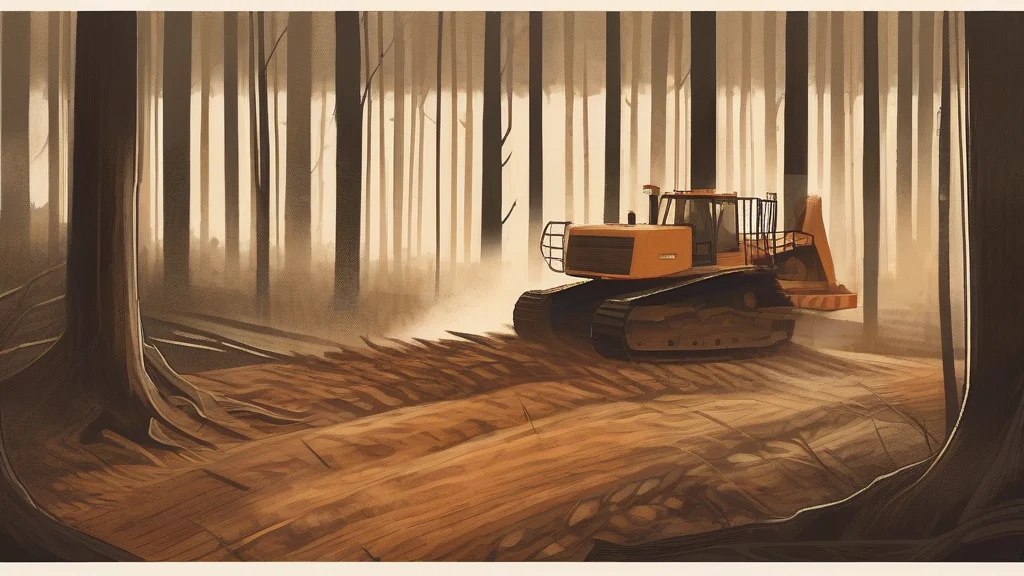
Clearcutting is a forestry practice in which virtually all trees in a defined area are felled at the same time, leaving the land largely bare. Used extensively in commercial timber harvesting, especially in North America, it allows efficient, mechanized extraction of wood but removes an entire forest stand in one operation. The word functions mainly as an uncountable noun naming the practice, though it also serves as the gerund form of the verb 'to clearcut'. Publicly, clearcutting has become one of the most charged terms in environmental debate: critics associate it with habitat loss, soil erosion, degraded watersheds, and carbon release, while some foresters argue it is an appropriate regeneration method for shade-intolerant species such as pines and Douglas fir. In everyday writing it appears most often in journalism, policy documents, and activism, usually contrasted with alternatives like selective cutting or shelterwood systems. Its synonym 'clear-felling' is preferred in British English, making regional awareness useful when reading forestry literature.
The practice or act of felling and removing all trees in a designated area of forest at once, typically for commercial timber harvest.
"Satellite imagery revealed the extent of clearcutting across the boreal forest."
Usually treated as an uncountable noun referring to the practice as a whole.
The present participle or gerund of 'to clearcut': to engage in or carry out the felling of all trees in an area.
"They were fined for clearcutting land without a permit."
'Clearcutting' names a practice and is normally uncountable; individual cleared areas are referred to as 'clearcuts' or 'clear-cuts', which do take a plural.
"Several clearcuts scarred the mountainside above the valley."
A single pass of clearcutting can erase a forest that took centuries to grow in a matter of weeks.
Reviewed by Deb Chak, Editor. AI-assisted content curated by RJS Tech Solutions LLP.
Etymology of clearcutting
Clearcutting is a modern compound term formed from 'clear' plus 'cutting', describing the complete clearing of standing timber by cutting. The practice itself dates back centuries in Europe, where whole stands were felled for agriculture and shipbuilding, but the specific English term emerged alongside large-scale industrial logging in North America during the nineteenth and twentieth centuries. It derives entirely from native Germanic roots — 'clear', from Old English clǣne via Old French cler, ultimately Latin clarus, and 'cut', from Old English cyttan — so its components share ancestry with words like clarity and clarify on one side and ordinary cutting vocabulary on the other.
Related word forms
How clearcutting is actually used
The term carries strongly negative environmental connotations in public discourse, though foresters sometimes defend it as a legitimate silvicultural method for certain sun-loving species. 'Clearcutting' is standard in North American English; British usage more often prefers 'clear-felling' for the same practice. It is typically used as an uncountable mass noun referring to the practice rather than a countable one.
Easily confused with clearcutting
Selective cutting removes only some trees while leaving the stand intact, whereas clearcutting removes all trees in an area.