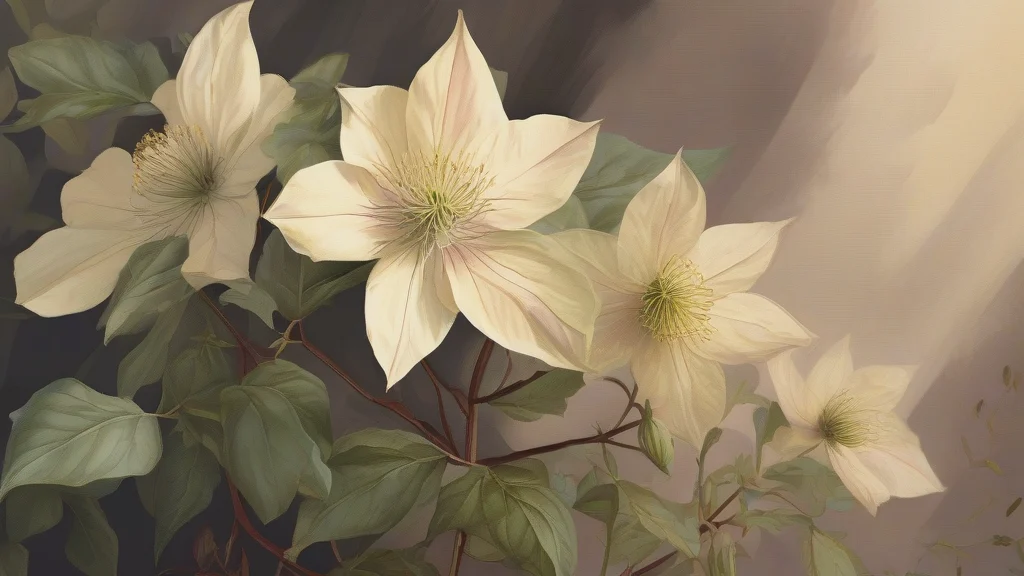
What does clematis mean?
Clematis is a large genus of mostly climbing plants in the buttercup family, Ranunculaceae, prized by gardeners for their abundant and often spectacular flowers. Species range from vigorous woody vines that scramble over walls, fences, and trees to smaller herbaceous perennials, and their blossoms appear in shades of white, pink, purple, blue, and yellow, typically in spring, summer, or autumn depending on the variety. The word functions as a countable noun with the plural 'clematises'. In everyday English, 'clematis' appears almost exclusively in horticultural conversation — in planting guides, garden centres, and show benches — where it carries pleasant connotations of cottage gardens and lush vertical colour. Because different species flower and prune differently, gardeners sort them into pruning groups, making clematis both a beloved ornamental and a subject of genuine horticultural know-how. It remains one of the most popular climbing plants grown worldwide.
nounA genus of climbing shrubs and herbaceous perennials of the buttercup family (Ranunculaceae), cultivated for their showy, often large flowers in a wide range of colours.
- Any plant of the genus Clematis, especially a climbing or sprawling shrub grown ornamentally for its flowers.
"The clematis scrambling over the garden wall burst into purple bloom in late spring."
"She trained the clematis up an obelisk so its violet stars would catch the morning sun."
"Pruning groups matter with clematis: cutting back at the wrong season can sacrifice an entire year of blooms."
The regular English plural 'clematises' is standard; the Latinate form 'clematides' also occurs in botanical writing but is less common in everyday use.
"The nursery stocked dozens of clematises, from compact border types to rampant montana hybrids."
Gardeners call it the 'queen of climbers' — and one species, traveller's joy, was so named because old hedgerows draped in it signposted the way home for weary walkers.
Reviewed by Deb Chak, Editor. AI-assisted content curated by RJS Tech Solutions LLP.
Etymology of clematis
Clematis entered English in the early seventeenth century, taken directly from Latin clematis, which itself borrowed from Greek klēmatís, a name for various climbing plants. The Greek term ultimately derives from klēma, meaning a twig or vine shoot — fitting for a plant that climbs by twining its leaf stalks around supports. Its relatives in modern English are few, since the root stayed largely within botanical naming rather than spreading into common vocabulary.
How clematis is actually used
Used chiefly in gardening and botanical contexts; always lowercase 'c' except at the start of a sentence, since it names a genus rather than being a proper name. Plural is usually 'clematises', though botanists sometimes use the Latin-style 'clematides'.
Easily confused with clematis
A clementine is a small citrus fruit, while a clematis is a flowering climbing plant; the two share only the beginning of the word.