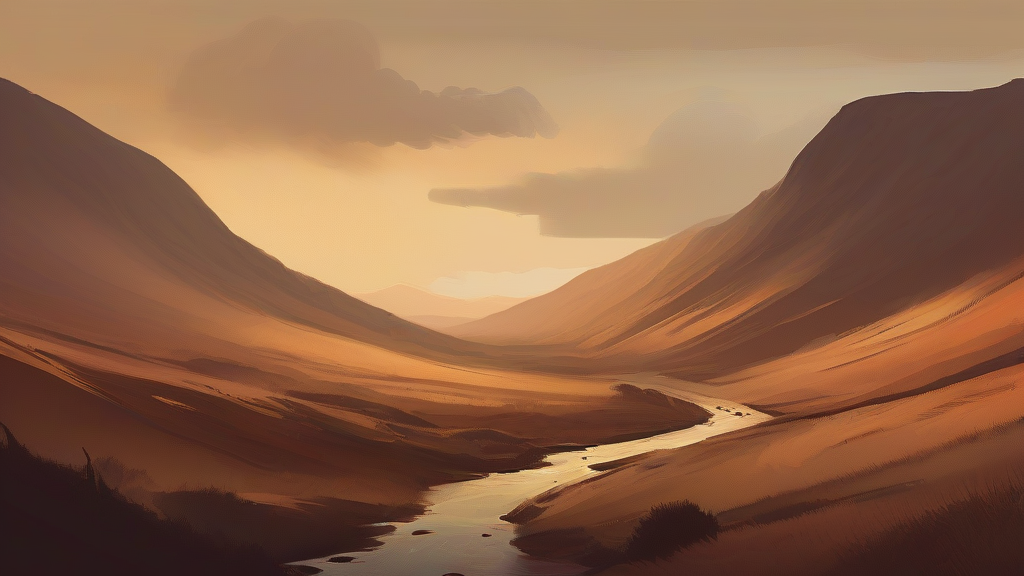
What does cleuch mean?
A cleuch is a deep, steep-sided valley or ravine, typically cut by a stream through rocky upland country. The word belongs firmly to the vocabulary of Scotland and northern England, where it has long been used to describe the dramatic gorges and gullies of the Borders, the Cheviots, and similar landscapes. It appears most often today in regional writing, rural description, and place-names rather than in everyday speech, giving it a distinctly local and literary flavour. For anyone walking or reading about Border country, however, it remains a precise and evocative term: where a generic word like 'valley' suggests something broad and gentle, a cleuch implies narrowness, steepness, and rock. The word is closely related to 'cleugh,' a common variant spelling of the same term, and to 'clough,' its northern English counterpart. Its enduring presence in maps and place-names makes it a rewarding word for lovers of topography and dialect alike.
nounA steep, narrow valley or ravine; a deep rocky gorge, especially one carved by a stream in the border country of Scotland and northern England.
- A steep, narrow valley or ravine; a deep rocky gorge, typically in upland terrain.
"The sheep trail wound down into the cleuch, where a burn ran cold between mossy crags."
"The hikers paused at the lip of the cleuch, watching the burn tumble far below."
"Field boundaries and farm tracks often follow the edge of a cleuch in the Cheviots."
The plural follows the regular English pattern. The variant spelling 'cleughs' occurs alongside the alternative form 'cleugh.'
"The map marked several cleuchs cutting into the hillside above the village."
Before 'glens' got all the glory, Scotland's Border country mapped its wild gullies with this rugged little word — one that shares its ancient roots with 'cliff' and 'cleave.'
Reviewed by Deb Chak, Editor. AI-assisted content curated by RJS Tech Solutions LLP.
Etymology of cleuch
The word derives from Old English 'clēoh' (also appearing as 'clēow'), meaning a cliff or rocky slope, from the Germanic root that also gives us 'cliff' and 'cleave' (in the sense of splitting rock). It passed into Scots and northern Middle English, where it became the standard local term for a steep ravine or gorge. The form 'cleugh' arose as a common variant spelling of the same word, and 'clough' represents a closely related northern development of the same Old English root. Its use has remained largely confined to Scotland and northern England since at least the medieval period.
Related word forms
How cleuch is actually used
A regional, somewhat literary or antiquarian term found chiefly in Scots and northern English usage, especially in place-names and landscape writing of the Border counties. It is rare outside these areas and would strike most modern readers as unfamiliar.
Easily confused with cleuch
Cleugh is simply the more common variant spelling of the same word, both denoting a steep valley or ravine in Scottish and northern English usage.
Clough is a related northern English dialect word from the same Old English root, but it is a distinct spelling and form referring to a similar steep-sided valley or ravine.