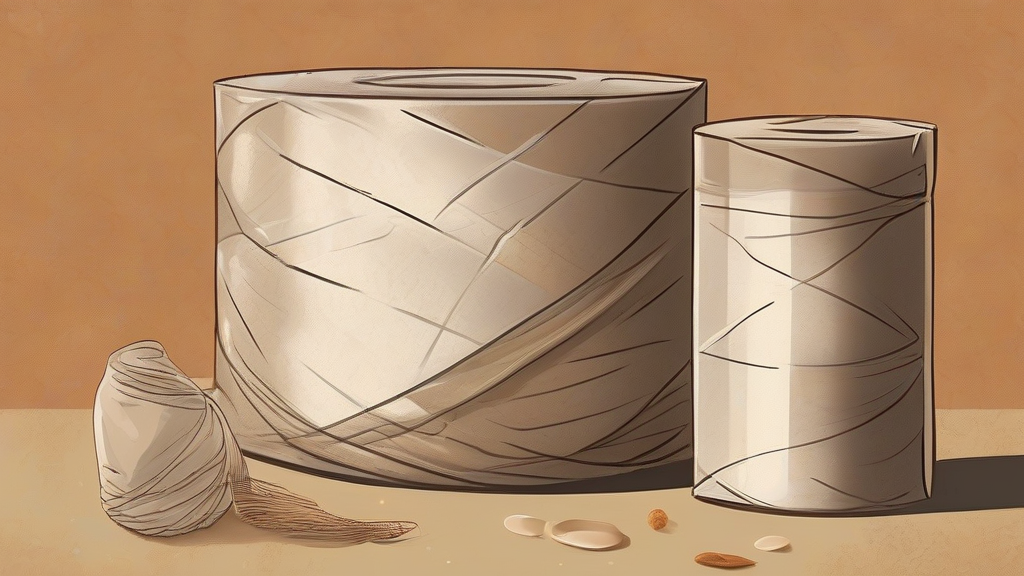
What does clingwrap mean?
Clingwrap is a thin, transparent plastic film used chiefly in kitchens to wrap and seal food, keeping it fresh by excluding air and moisture. Its defining property is self-adhesion: the film clings lightly to itself and to smooth surfaces such as glass and ceramic, allowing it to form an airtight cover over bowls, plates, and cut produce without tape or ties. The word functions as both a mass noun ('a roll of clingwrap') and, informally, as a verb meaning to cover something with the film. Regional vocabulary varies considerably: British English favors 'cling film', American English commonly uses 'plastic wrap' or the trademarked 'Saran wrap', and Australian English often says 'Glad wrap'. Despite these naming differences, the product itself is universal—a humble but indispensable tool of modern food storage, valued for its cheapness, flexibility, and near-invisible transparency.
A thin, transparent plastic film that adheres to itself and to surfaces, used to wrap food and keep it fresh.
"There's a roll of clingwrap in the drawer next to the foil."
Often treated as an uncountable mass noun; a portion is measured as 'a sheet' or 'a piece' of clingwrap.
(informal) To cover or wrap something in clingwrap.
"Clingwrap the salad bowl and pop it in the fridge."
Informal back-formation from the noun; inflected as clingwrapped / clingwrapping.
Usually uncountable when referring to the material itself; the plural applies mainly to rolls or types of the product.
"We go through several clingwraps a year in this kitchen."
That satisfying way clingwrap clings only to itself—and never quite to the bowl—is thanks to static electricity and its slight adhesive coating.
Reviewed by Deb Chak, Editor. AI-assisted content curated by RJS Tech Solutions LLP.
Etymology of clingwrap
Clingwrap is a transparent compound of the native English verbs 'cling' and 'wrap', coined in the twentieth century after self-clinging plastic films were introduced commercially in the mid-1900s. 'Cling' descends from Old English 'clingan', meaning to adhere or shrivel together, and is related to words such as 'clench' and 'clinch', which share the same Germanic root conveying gripping or fastening. The compound arose as a descriptive trade and household name for the new material, alongside regional rivals like 'cling film' in Britain.
How clingwrap is actually used
The compound is written variously as one word, hyphenated (cling-wrap), or as two words (cling wrap); all are accepted. In everyday American English, 'plastic wrap' or the trademark 'Saran wrap' is more common, while British speakers typically say 'cling film'. The word is informal-to-neutral in register and appears mostly in domestic, kitchen contexts.
Easily confused with clingwrap
Cling film is the standard British term for the same product, whereas clingwrap is a more general compound used in both British and American English.