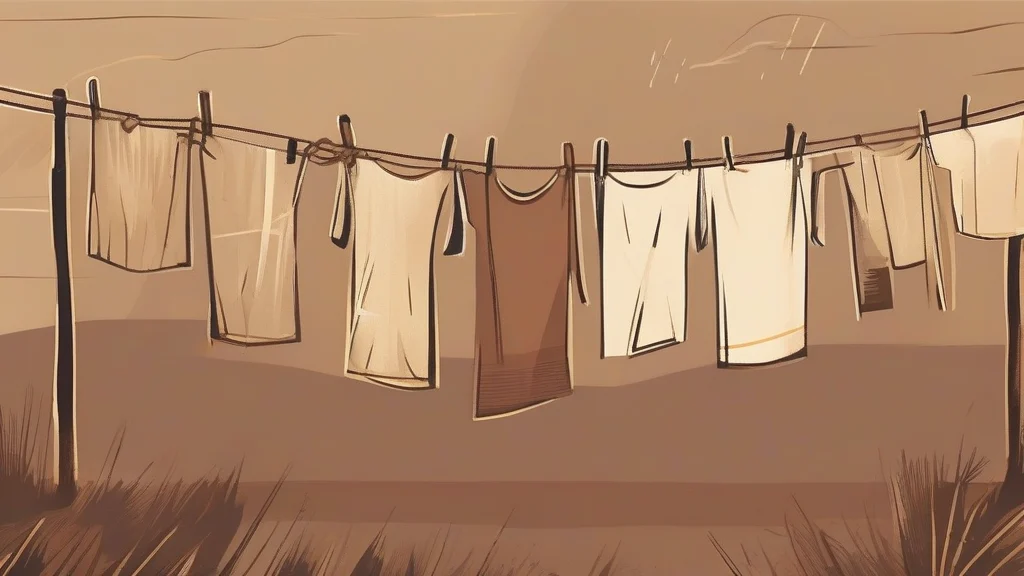
What does clothesline mean?
A clothesline is a length of rope, cord, or wire stretched between two fixed points—usually poles, posts, trees, or a pulley system—on which freshly washed laundry is hung to dry naturally in the air and sunshine. The word combines 'clothes' with 'line' and dates from the nineteenth century, when outdoor drying became a routine part of domestic life. Using one requires only clothespins or pegs and a breezy day; the practice remains common worldwide for its low cost, gentle treatment of fabric, and fresh scent, though it has declined where tumble dryers dominate. Beyond its literal meaning, 'clothesline' has entered sports vocabulary: in football and wrestling commentary it describes a stiff-armed blow that stops a moving opponent cold, named for the way a runner strikes an unseen line. The noun is ordinary in tone, with no negative connotation, though debates over community rules that prohibit visible lines have made it a small symbol of domestic freedom.
A rope or cord strung between supports, on which washed laundry is hung to dry.
"Mum always said nothing smelled better than sheets taken down from the clothesline."
British speakers frequently prefer 'washing line.'
(Informal, chiefly in sports) A blow struck with a rigid extended arm against an opponent's upper body or head, stopping their forward motion.
"The linebacker leveled the receiver with a textbook clothesline."
This extended sense comes from American football and professional wrestling commentary.
Regular plural formation. Commonly used when describing multiple households' lines or several strung lines.
"Backyards all along the street were strung with sagging clotheslines."
Before electric dryers existed, every household's weather forecast was written on its clothesline — and some neighborhoods still ban them as 'eyesores,' sparking 'right-to-dry' laws across America.
Reviewed by Deb Chak, Editor. AI-assisted content curated by RJS Tech Solutions LLP.
Etymology of clothesline
Clothesline is a straightforward compound of 'clothes,' from Old English 'clāthas' (plural of 'clāth,' meaning cloth), and 'line,' from Old English 'līne,' ultimately from Latin ' linea,' meaning a linen thread or string. The compound arose in the nineteenth century as outdoor air-drying of laundry became standard domestic practice. Its cognates are simply the Germanic and Latinate words sharing those two roots, such as 'cloth,' 'clothing,' and 'linen.'
How clothesline is actually used
The word is everyday and unmarked in register. British English more often uses 'washing line' or 'drying line'; 'clothesline' remains fully understood but slightly less common in the UK. The second sense, borrowed from American football and professional wrestling, is informal and chiefly North American.
Easily confused with clothesline
A clothespin is the small clip used to fasten laundry to the line, while the clothesline is the rope itself.