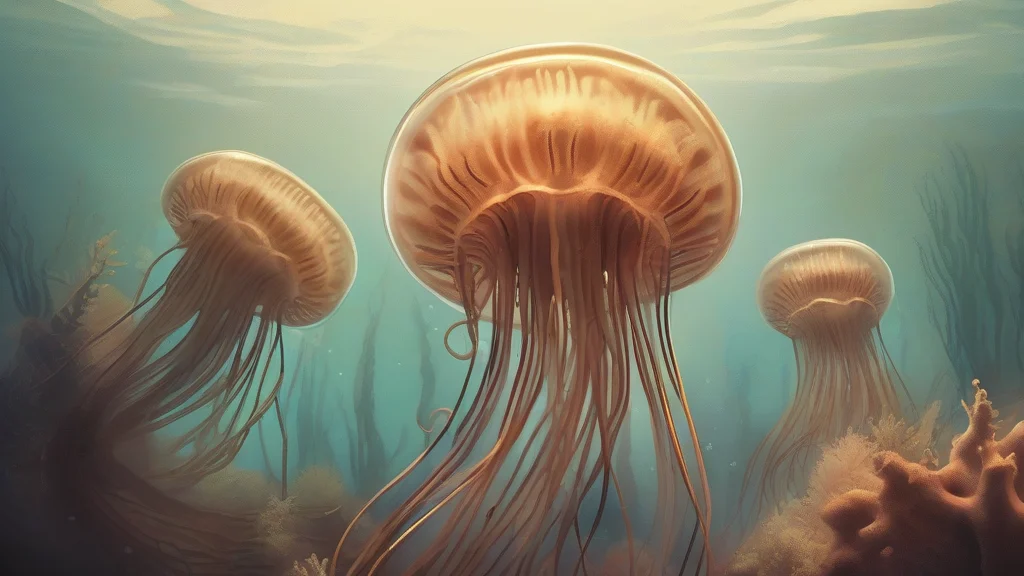
What does cnidarian mean?
A cnidarian is any member of the phylum Cnidaria, a diverse group of aquatic animals that includes jellyfish, corals, sea anemones, hydroids, and sea fans. Nearly all cnidarians live in marine environments, though a few inhabit fresh water. What unites them are two defining features: radial symmetry and cnidocytes, specialized cells containing stinging organelles used to capture prey and defend against predators. Many cnidarians alternate between two body forms during their lives — a sessile polyp, like a sea anemone or coral polyp, and a free-swimming medusa, like a jellyfish. The term derives from the Greek "knide," meaning nettle, a nod to their stinging capability. Although "cnidarian" is chiefly a scientific term found in biology texts, documentaries, and journalism about marine life, it is worth knowing because cnidarians include some of the ocean's most ecologically important creatures — coral reefs support roughly a quarter of marine species — as well as some of its most dangerous, such as the box jellyfish.
nounA member of the animal phylum Cnidaria, a group of aquatic invertebrates that includes jellyfish, corals, sea anemones, and hydroids, characterized by radial symmetry and specialized stinging cells called cnidocytes.
- An individual organism of the phylum Cnidaria, such as a jellyfish, coral polyp, sea anemone, or hydroid.
- Used attributively to mean relating to or characteristic of the Cnidaria (e.g. 'cnidarian venom').
"The reef's vivid colors were produced almost entirely by tiny cnidarians — the coral polyps themselves."
"Scientists studying the box jellyfish noted that this cnidarian packs venom powerful enough to be lethal to humans."
"The fossil record suggests that cnidarians existed more than 500 million years ago, long before the first fish appeared."
The regular plural "cnidarians" is standard and commonly used when referring to multiple organisms or the group as a whole.
"Cnidarians range from microscopic hydrozoans to lion's mane jellyfish whose bells exceed two meters across."
Every jellyfish sting you've ever feared comes courtesy of a microscopic spring-loaded harpoon — the nematocyst — a weapon so fast it is one of the quickest movements in the entire animal kingdom.
Reviewed by Deb Chak, Editor. AI-assisted content curated by RJS Tech Solutions LLP.
Etymology of cnidarian
The word "cnidarian" comes from New Latin "Cnidaria," the name given to the phylum, which itself derives from the ancient Greek "knide" (κνίδη), meaning nettle — a reference to the stinging cells these animals possess. The English adjective/noun form emerged in the nineteenth century as zoologists refined their classification of radially symmetrical aquatic invertebrates. Related coinages sharing the same Greek root include "cnidocyte," the name of the stinging cell itself. The silent initial "c" reflects the transliteration of the Greek letter cluster into Latin and then English spelling.
How cnidarian is actually used
"Cnidarian" is primarily a scientific and technical term, used in biology, marine science, and educational contexts rather than everyday conversation. The initial "c" is silent, which frequently surprises new readers. In older literature the word may appear as part of "coelenterate," a term now considered outdated by most taxonomists. The adjective sense (e.g. "cnidarian cells") is common in technical writing.
Easily confused with cnidarian
Coelenterate is an older, now largely obsolete grouping that lumped cnidarians together with ctenophores (comb jellies), whereas cnidarian is the modern, precise term for members of phylum Cnidaria.
A ctenophore is a comb jelly belonging to a separate phylum; unlike cnidarians it lacks stinging cells and moves using rows of ciliary combs.