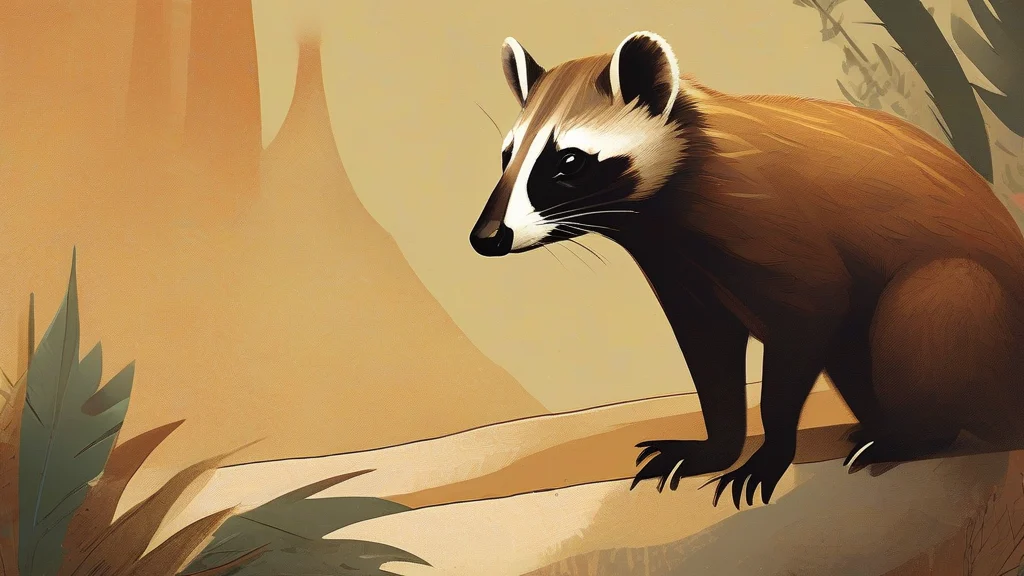
What does coati mean?
A coati is a mammal belonging to the genus Nasua (and the smaller mountain coatis of the genus Nasuella), found from the southwestern United States through Mexico into Central and South America. Related to raccoons, it has a slender body, a long banded tail it often carries upright, and above all an elongated, highly flexible snout used to probe soil and crevices for insects, fruit, and small animals. Coatis are social: females and their young travel in bands, while adult males are usually solitary — a lone male was once thought to be a separate species and called a "coatimundi." The word entered English by way of Spanish and Portuguese from an indigenous language of Brazil. Coatis appear frequently in nature writing and wildlife documentaries about Neotropical forests.
nounA coati is a mammal of the genus Nasua (and the related genus Nasuella), native to Central and South America and parts of Mexico, related to the raccoon, with a long ringed tail, a slender snout, and a habit of foraging in groups.
- A carnivorous mammal of the genus Nasua (or Nasuella), related to raccoons, native to the Americas, having a long flexible snout and a long ringed tail.
"A troop of coatis trotted along the forest floor, tails erect, sniffing the leaf litter for insects."
"The white-nosed coati ranges from Arizona through Mexico into South America."
"At the zoo, the coatis spent the afternoon digging for grubs with their long snouts."
The standard plural is "coatis." Some sources also allow treating the word as invariant, but "coatis" is the usual form in modern usage.
"Troops of coatis can number twenty individuals or more."
Coatis walk with their ringed tails pointing straight up like little antennae — and despite looking like raccoons, they're just as happy in trees as on the ground.
Reviewed by Deb Chak, Editor. AI-assisted content curated by RJS Tech Solutions LLP.
Etymology of coati
The word "coati" entered English around the early seventeenth century via Spanish and Portuguese, borrowed from Tupi, an indigenous language family of Brazil, in which the animal was called something like kua'ti. It thus belongs to the small set of English animal names drawn from indigenous Brazilian languages, alongside words such as "jaguar," "tapir," and "piranha." The variant "coatimundi" arose later, popularized by naturalists who believed the solitary male represented a distinct species.
How coati is actually used
The word is used in both formal scientific writing and general natural-history contexts. The variant form "coatimundi" is common but often refers specifically to a lone adult male, since males typically live apart from the bands of females and young.
Easily confused with coati
A raccoon is a related North American mammal with a masked face and bushy tail, whereas a coati has an elongated, flexible snout and is native to Central and South America.