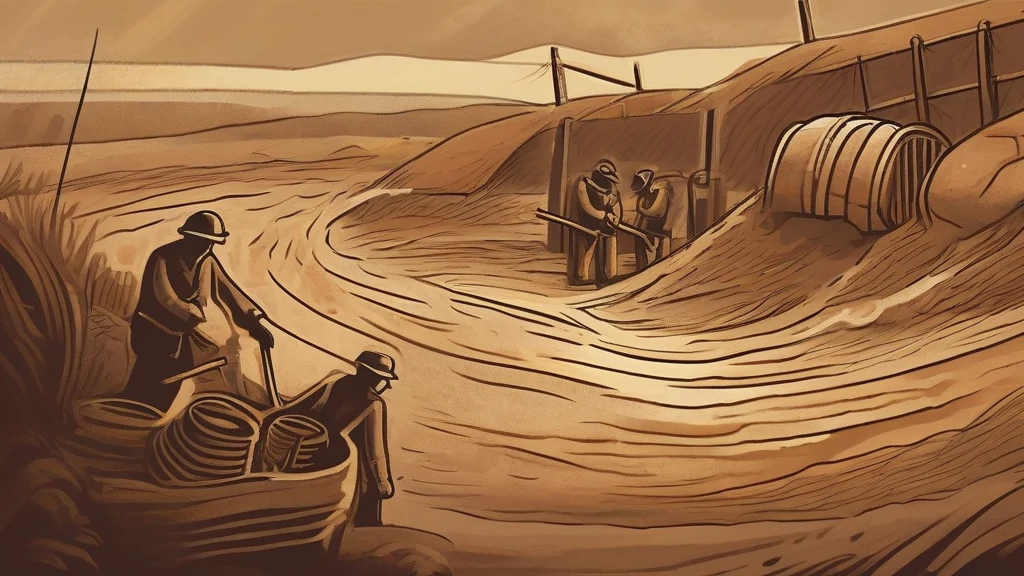
What does cobbing mean?
Cobbing is an English verbal noun with three distinct strands of meaning. Its most familiar use, chiefly British and informal, denotes the act of striking or thrashing someone, as in receiving 'a good cobbing'. A second, more specialized sense belongs to natural building, where cobbing describes constructing walls from cob — a humble yet durable mixture of subsoil, sand, straw and water that has sheltered dwellers in Devon and beyond for centuries. A third, now largely obsolete meaning comes from historic mining, where cobbing meant breaking and sorting ore by hand with a hammer before smelting. Despite their differences, all three senses trace back to the versatile Middle English word 'cob', itself of obscure origin. Today the word survives mainly in dialect writing, heritage-building circles, and accounts of old mining life, giving it a pleasantly rustic, old-fashioned flavour wherever it appears.
Present participle of 'cob': to strike or beat someone.
"The village constable threatened the troublemaker with another cobbing if he misbehaved again."
An act of striking or beating; also, in building, the process of working with cob material.
"A sound cobbing taught him not to mock the referee's eyesight."
Long before 'cobbing' meant getting a thumping, miners used cobbing hammers to crack rock by hand — one word, two very sore hands.
Reviewed by Deb Chak, Editor. AI-assisted content curated by RJS Tech Solutions LLP.
Etymology of cobbing
Cobbing derives from the verb 'cob', recorded in Middle English and ultimately of uncertain origin, possibly imitative or related to Old Norse 'kobbi' (a seal). From the base sense of a lump or rounded mass came the senses of a lumpish blow — hence to cob meaning to strike — as well as cobblestone and the earthen building material cob. The mining verb arose from breaking ore into small lumps, while the building term reflects shaping walls from lumps of earth-straw mix. Related formations include cobble, cobblestone, and cobwall.
Related word forms
How cobbing is actually used
As a term for hitting someone, 'cobbing' is chiefly British and informal, often found in dialectal or historical writing rather than everyday modern speech. The building sense is technical but current among practitioners of natural and sustainable construction, particularly in South West England and parts of North America. The mining sense is largely obsolete and appears mainly in older texts about Cornish or Derbyshire lead mining.
Easily confused with cobbing
Cobbling refers to mending shoes or clumsily patching things together, whereas cobbing means hitting someone, working with cob earth, or hand-breaking ore.