What does cockchafer mean?
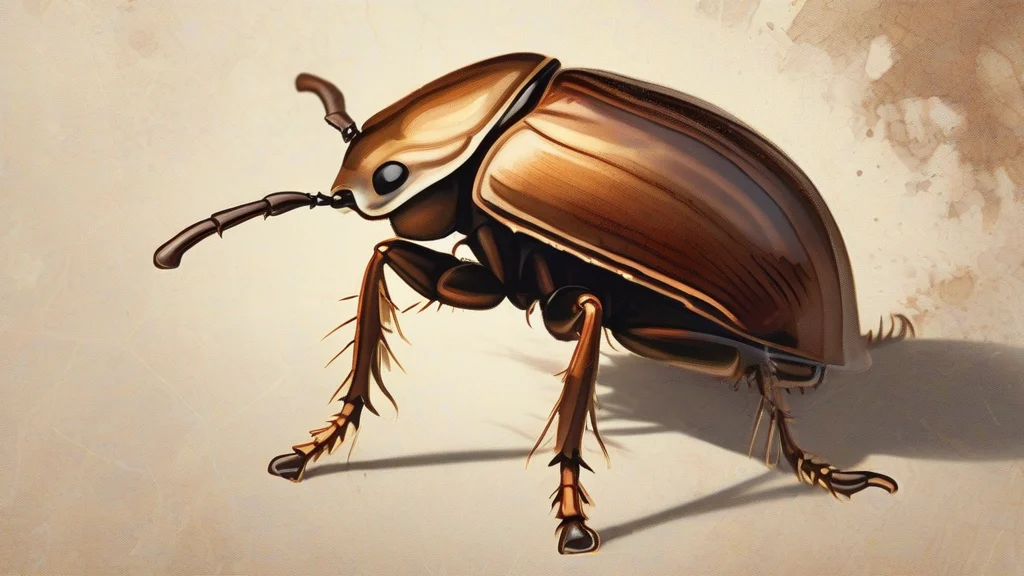
A cockchafer is a large, chunky brown beetle native to Europe, scientifically named Melolontha melolontha and familiarly known as the May bug because it typically takes to the air on warm evenings in late spring. Reaching around three centimetres in length and distinguished by its fan-like antennae, it is a member of the scarab family. Although the adult beetle is harmless to people, feeding mainly on leaves, its thick white grubs live underground for several years and chew through the roots of grasses, cereals, and potatoes, making it a serious agricultural pest. Before modern pesticides, cockchafer outbreaks devastated farmland on a scale that prompted bounties for collected grubs. In everyday language the word appears mostly in British rural and natural-history contexts, often evoking nostalgia through phrases like 'the hum of cockchafers on a summer evening'.
nounA large brown European beetle (Melolontha melolontha) of the scarab family, which flies at dusk in late spring and whose white grubs feed on the roots of grasses and crops.
- The European scarab beetle Melolontha melolontha, known as the May bug, which emerges in late spring and whose larvae damage grassland and crops.
"The garden was overrun by cockchafers, their fat white gruns gnawing through the lawn's roots."
"A cockchafer blundered against the window, drawn to the lamp on a warm May evening."
"The farmer ploughed the field early to expose the cockchafer grubs to the birds."
Regular plural; used both for individual beetles seen together and when discussing infestations of grubs.
"The orchard trees rustled with cockchafers after sunset."
Cockchafers were once such a menace to European crops that towns offered bounties for every grub collected — schoolchildren included.
Reviewed by Deb Chak, Editor. AI-assisted content curated by RJS Tech Solutions LLP.
Etymology of cockchafer
The word cockchafer derives from Middle English, combining 'cock' (used in an emphatic or size-implying sense) with 'chafer', an Old English term (ceafer) meaning simply a beetle or chewing insect. The compound dates from the early modern period, with forms like 'cokchafer' appearing in sixteenth-century texts. The underlying root also survives in continental Germanic languages, as seen in German Käfer, meaning beetle.
How cockchafer is actually used
The term is chiefly British and somewhat old-fashioned or rural in register; Americans more often say 'May beetle' or 'June beetle' for similar insects. It carries mildly nostalgic or literary connotations in British writing.
Easily confused with cockchafer
'Chafer' is the general term for any beetle of the subfamily Melolonthinae, while 'cockchafer' refers specifically to the large European species Melolontha melolontha.
Despite the shared 'cock-' prefix, a cockchafer is a harmless outdoor scarab beetle, whereas a cockroach is an indoor household pest of an entirely different insect order.