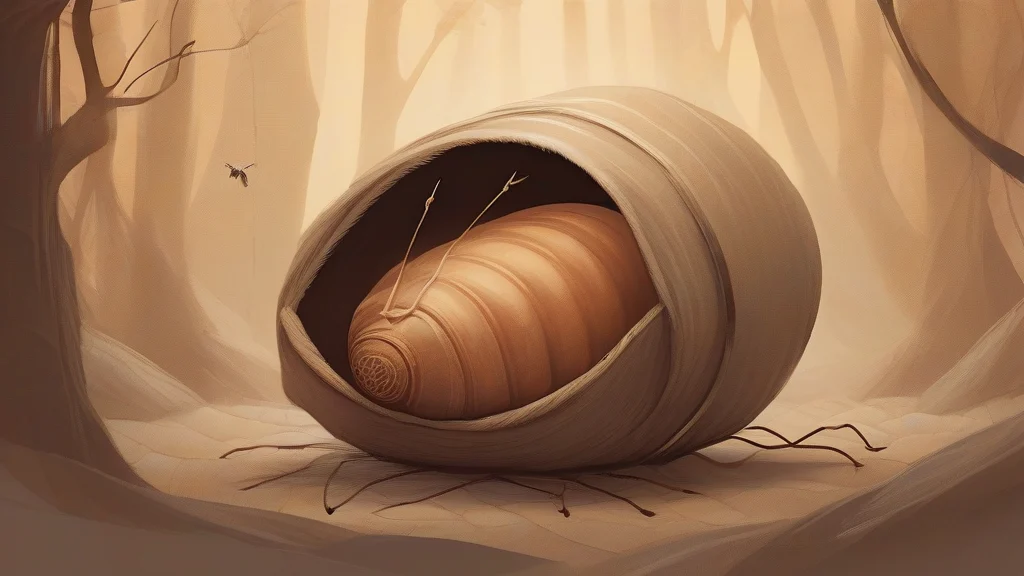
What does cocoon mean?
A cocoon is the silky case that many insect larvae—most famously those of moths and certain beetles—spin around themselves as they enter the pupal stage of metamorphosis. Within this protective wrapping, the insect's body is broken down and reorganized, eventually emerging as an adult. The word has also taken on a rich figurative life: to be 'in a cocoon' is to be wrapped in comfort, warmth, or seclusion, whether literally under blankets or metaphorically shielded from the harsher realities of life. As a verb, 'to cocoon' means to swaddle or enclose protectively, as in cocooning oneself at home on a winter evening. Derived through French from southern European roots, the word entered English in the late seventeenth century. Its enduring appeal lies in the powerful image it evokes: transformation, safety, and quiet renewal within a self-made shell.
A silky protective case spun by the larvae of many insects, especially moths, in which the pupa develops; also, by extension, any snug, enveloping shelter or environment.
"The gardener carefully moved the branch, leaving each delicate cocoon undisturbed."
Strictly, butterflies form a chrysalis rather than spinning a cocoon, though the terms are popularly conflated.
To wrap or envelope someone or something completely and protectively, as if in a cocoon.
"The cabin was so well insulated that it seemed to cocoon its occupants against the storm."
Standard regular plural; used both literally (for multiple insect cases) and figuratively.
"Dozens of pale cocoons hung beneath the leaves of the hedge."
Every cocoon is a one-insect sleeping bag, hand-spun from a single continuous thread of silk that can stretch hundreds of metres.
Reviewed by Deb Chak, Editor. AI-assisted content curated by RJS Tech Solutions LLP.
Etymology of cocoon
The word 'cocoon' entered English in the late seventeenth century from French 'cocon', which itself traces back to Provençal (Occitan) 'coco', meaning a shell or husk. The ultimate origin of the Occitan term is uncertain, though some sources connect it to Mediterranean words for egg-shells and husks. Its earliest English uses referred directly to the silk casings of silkworms, reflecting the word's close ties to the silk trade before it broadened to other insects and then to figurative senses of enclosure and comfort.
How cocoon is actually used
As a noun, 'cocoon' is neutral in register and common in both scientific and everyday contexts; the figurative use often carries warm, protective connotations but can suggest overprotection or isolation ('cocooned from reality'). The verb form 'to cocoon' is well established, especially in the passive or reflexive ('she cocooned herself').
Easily confused with cocoon
A chrysalis is the exposed pupa of a butterfly, while a cocoon is a silk casing spun by many moth larvae to enclose their pupa.
A 'cacoon' is the large bean-like fruit of a tropical liana, unrelated to the insect cocoon despite the near-identical spelling.