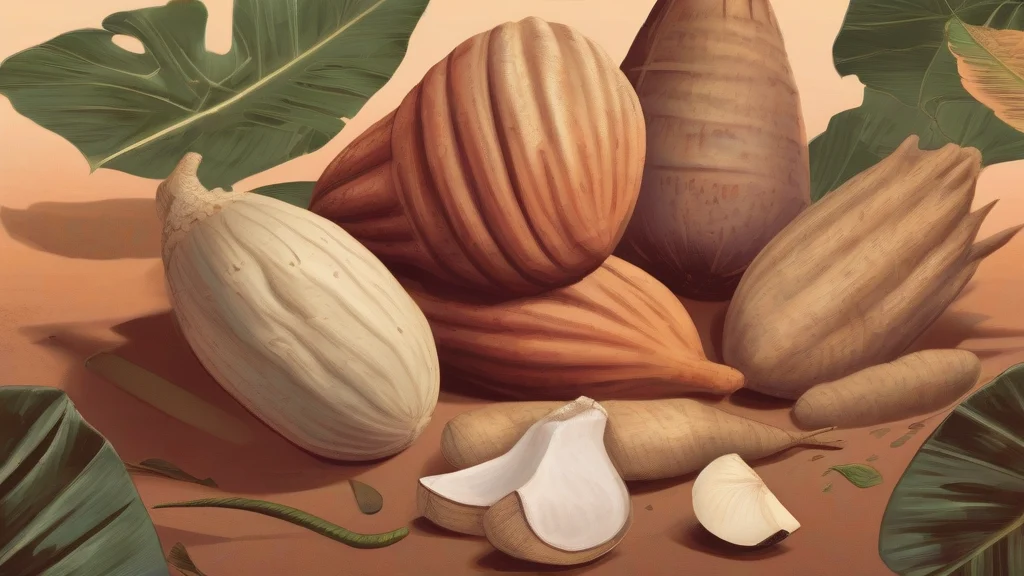
What does cocoyam mean?
Cocoyam is the common name for several tropical plants of the arum family, principally species of Colocasia and Xanthosoma, that are widely cultivated for their edible, starch-rich underground stems. The word also denotes the corms and tubers themselves, which are boiled, roasted, pounded into dough-like dishes, or ground into flour across West Africa, the Caribbean, and the Pacific. Despite its name, cocoyam is not a true yam; the label arose because European traders and colonists applied 'yam' loosely to unfamiliar starchy staples. In everyday speech the term belongs mainly to West African, Caribbean, and Pacific varieties of English, where it carries warm associations of home cooking and traditional agriculture. Elsewhere, closely related plants go by names such as taro, dasheen, eddo, or malanga, so context matters when using the word.
A tropical aroid plant of the genera Colocasia or Xanthosoma, cultivated for its edible starchy corms and tubers.
"Cocoyam grows well in the wet, fertile soils of the river valleys."
Often used collectively or as a mass noun when referring to the crop.
The edible corm or tuber of this plant, eaten boiled, pounded, roasted, or milled into flour.
"He bought three tubers of cocoyam at the market for tonight's soup."
Countable when referring to individual tubers; often uncountable when referring to the crop or foodstuff generally.
"The stall was piled high with fresh cocoyams."
Cocoyam isn't actually a yam at all — it's an aroid cousin of taro whose name simply borrowed 'yam' as a handy label for any starchy tropical staple.
Reviewed by Deb Chak, Editor. AI-assisted content curated by RJS Tech Solutions LLP.
Etymology of cocoyam
The word cocoyam combines 'coco', likely from a Caribbean or African source, with 'yam', which entered English from West African languages such as Fulani and Wolof during the era of Atlantic trade. The compound arose among English speakers in West Africa and the Caribbean who needed a convenient label for aroid staples that resembled yams but belonged to entirely different plant families. It has been in use since at least the nineteenth century and remains standard vocabulary in Nigerian, Ghanaian, and Caribbean English today.
How cocoyam is actually used
The term is chiefly used in West African, Caribbean, and Pacific Englishes; in other varieties speakers more often say taro, dasheen, eddo, or malanga depending on the exact species. Because 'cocoyam' covers more than one botanical genus, its precise referent varies by region.
Easily confused with cocoyam
Despite the shared element in its name, cocoyam is not a true yam (Dioscorea); it is an unrelated aroid plant with different corm structure and flavor.
Taro refers specifically to Colocasia esculenta, while cocoyam is a broader regional term that can also cover Xanthosoma species.