
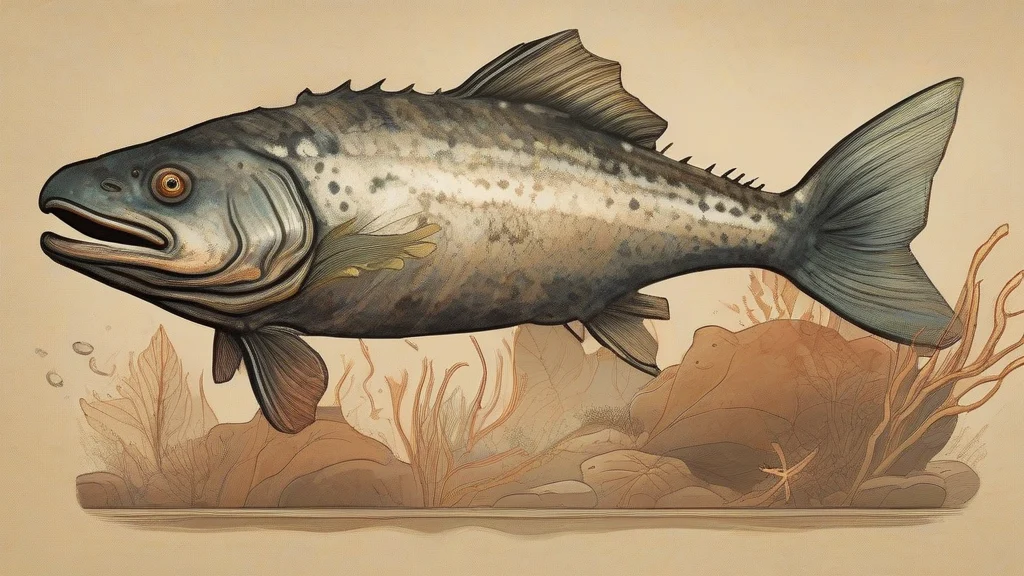
What does coelacanth mean?
A coelacanth is a remarkable member of the lobe-finned fish, the group that also includes lungfishes and the ancestors of land vertebrates. Only two living species are known, both inhabiting the western Indian Ocean at depths of roughly 100 to 500 metres. Because recognizable coelacanth fossils are abundant in rocks from the Paleozoic and Mesozoic eras, the group was long believed to have become extinct around the end of the Cretaceous period. The discovery of a living specimen in 1938 transformed it into a symbol of evolutionary persistence and earned it the description “living fossil.” This label is suggestive rather than literally exact: coelacanths have continued to evolve and are not frozen in an ancestral state. Today, “coelacanth” is used especially for the living West Indian Ocean fishes, while the plural also refers broadly to their many fossil relatives. The word is important in discussions of evolution, deep-sea biology, and the survival of ancient animal lineages.
nounA large, deep-bodied, lobe-finned fish of the order Coelacanthiformes, especially the rare living species known from the western Indian Ocean. Coelacanths also include numerous fossil relatives known from the Paleozoic and Mesozoic eras.
- One of the rare living fishes belonging to the order Coelacanthiformes, especially a member of the genus Latimeria found in the western Indian Ocean.
- Any member of the order Coelacanthiformes known from the fossil record.
"The museum's new coelacanth exhibit explains how this living relative of ancient lobe-finned fish has remained remarkably distinctive."
"Researchers carefully examined the coelacanth before returning it to the deep water where it had been caught."
"A fossil coelacanth from the Devonian period provides evidence about the early evolution of lobe-finned fishes."
The regular plural refers to multiple living coelacanths or, collectively, to living and fossil members of the group.
"Fossil coelacanths reveal how ancient lobe-finned fishes were built and distributed."
The coelacanth was thought to have vanished with the dinosaurs until a living specimen was discovered in 1938.
Reviewed by Deb Chak, Editor. AI-assisted content curated by RJS Tech Solutions LLP.
Where does coelacanth come from?
The English word was formed through New Latin from Greek koîlos, meaning “hollow,” and ákantha, meaning “thorn” or “spine.” The name refers to anatomical features of coelacanths, including their distinctive hollow-centered vertebral column. Several English scientific words, including coelom, coelenterate, celiac, and acoelous, are also derived from the same Greek element meaning “hollow.”
Related word forms
How coelacanth is actually used
The word is uncommon in everyday speech and is usually found in zoology, natural history, and science reporting. In singular form, it most often refers to a living fish, while the plural is commonly used for both living and fossil members. The expression “living fossil” is traditional and vivid, although it can misleadingly suggest that the animal has remained completely unchanged.