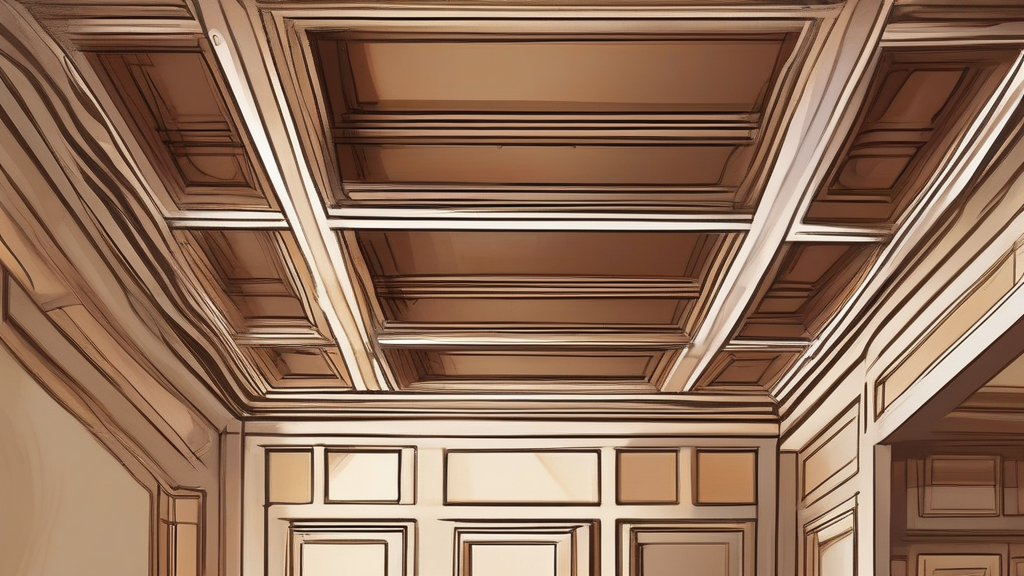
What does coffered mean?
Coffered describes a surface — most famously a ceiling — divided by intersecting beams into a regular grid of recessed panels, each sunken bay called a coffer or lacuna. Found everywhere from ancient Roman temples such as the Pantheon to Renaissance palaces and modern dining rooms, coffered ceilings are prized both structurally and decoratively: they reduce the apparent weight of a span while adding rhythm, depth, and shadow. The word derives from 'coffer', originally a chest or strongbox, so a coffered ceiling is literally one covered in small sunken boxes. In contemporary usage 'coffered' appears almost solely in architectural and interior-design contexts, where it signals elegance, solidity, and classical taste. A rarer verbal sense, now largely literary, uses 'coffered' to mean stored away in a treasury or strongbox, as in wealth 'coffered' behind thick walls. Whether describing oak beams above a dining table or gold locked out of sight, 'coffered' evokes containment, craft, and enduring value.
Of a ceiling or other structure: having a grid of recessed, sunken panels between intersecting ribs or beams.
"The library retained its original coffered ceiling of dark walnut."
Overwhelmingly found attributively, modifying 'ceiling'; rarely predicative.
Past tense and past participle of 'coffer': to place or lock up (money or valuables) in a chest or treasury.
"The proceeds were coffered until the dispute over ownership could be settled."
Literary or historical register; uncommon in modern prose.
The word 'coffered' comes from a box — literally. A coffer was a chest for valuables, and a coffered ceiling is one carved into sunken boxes overhead.
Reviewed by Deb Chak, Editor. AI-assisted content curated by RJS Tech Solutions LLP.
Etymology of coffered
The adjective 'coffered' comes from the verb 'to coffer', itself derived from the noun 'coffer', meaning a chest or strongbox for storing valuables. 'Coffer' entered English via Old French 'cofre', from Latin 'cophinus', meaning basket, which was borrowed from Greek 'kophinos' of the same sense. By extension, the recessed panels sunk into a ceiling came to be called 'coffers', since each resembles a little box; the participle 'coffered' thus came to describe ceilings so constructed, a usage well established in English by the seventeenth century.
Related word forms
How coffered is actually used
'Coffered' is used almost exclusively as an architectural adjective today, and nearly always before the noun 'ceiling'. It carries connotations of elegance, formality, and traditional craftsmanship — you will meet it in estate-agent listings, interior-design writing, and descriptions of banks, libraries, and public buildings. The verbal sense ('stored in coffers') survives mainly in literary or historical contexts, often in the passive.
Easily confused with coffered
'Coughed' refers to expelling air from the lungs with a harsh sound, while 'coffered' describes panelled architecture or money stored in coffers.