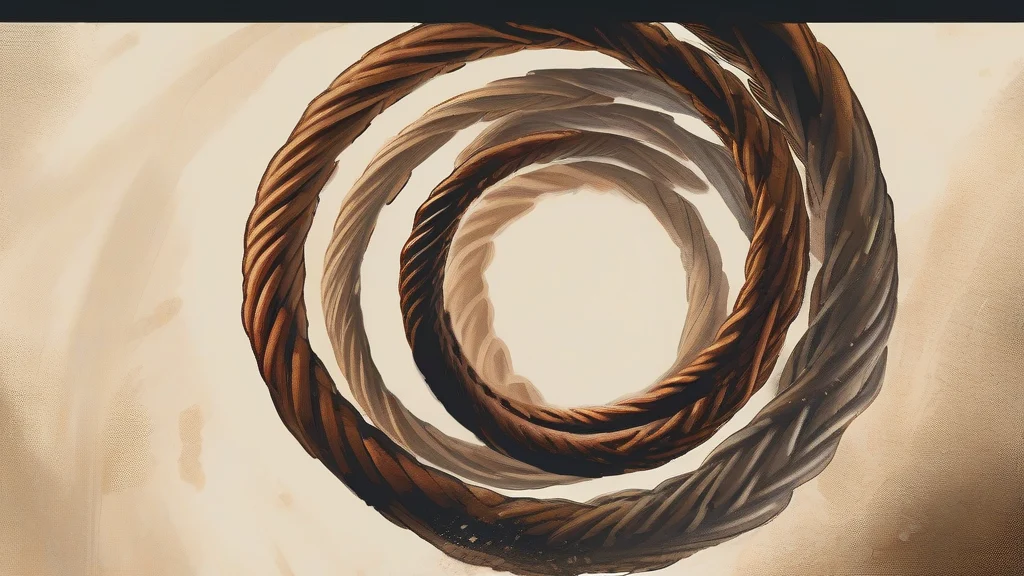
What does coiling mean?
Coiling is the act of winding something into a spiral, ring, or series of loops, and it also serves as an adjective describing anything that twists in this way. A gardener might spend a few minutes coiling a hose; a snake is described as coiling when it winds its body into tight curves; smoke rising from a fire may be seen coiling upward in graceful spirals. The word derives from the verb coil, which entered English in the early seventeenth century from Old French coillir, ultimately tracing back to the Latin colligere, meaning to gather together — the same root that produced words like collect and college. In everyday use, coiling suggests both practical tidiness, as with ropes and cables, and organic, sinuous movement, as with serpents and smoke. Its figurative uses often carry a sense of latent energy or menace, since a coiled thing appears ready to spring or unwind at any moment.
Present participle of coil: to wind into rings or a spiral, or to move in a twisting, spiral manner.
"He was coiling the rope neatly on the dock."
Also used figuratively for smoke, hair, or anything moving in spiral patterns.
A length of something, such as rope or wire, wound into concentric rings or a spiral.
"She grabbed a coiling of rope from the shed."
Less common than the simple noun 'coil'; usually used attributively or in technical contexts.
Winding or twisting in a spiral or serpentine manner.
"A coiling path led up the hillside."
Frequently used in literary description, especially of snakes, smoke, and roads.
Rarely used; the plural typically appears in technical or literary descriptions of multiple spiral forms.
"The sculpture was covered in intricate coilings of bronze wire."
Every coiled spring in every watch, mattress, and pen traces back to the same Latin verb that gave us 'collect' — coil literally means gathering things together, just very tightly.
Reviewed by Deb Chak, Editor. AI-assisted content curated by RJS Tech Solutions LLP.
Etymology of coiling
Coiling comes from the verb coil, first recorded in English in the early seventeenth century. It was borrowed from Old French coillir, meaning to gather or pick up, which itself descends from the Latin colligere, 'to gather together', formed from com- ('together') plus legere ('to gather, choose'). This same Latin root gives English its cognates collect, college, and colleague, all built on the idea of gathering things into one place.
Related word forms
How coiling is actually used
Most often encountered as the present participle of the verb 'coil'. As an adjective it carries vivid, sometimes ominous connotations — coiling smoke, a coiling serpent — making it popular in descriptive and literary prose.
Easily confused with coiling
Culling means selecting and removing items from a group, while coiling means winding into a spiral shape.