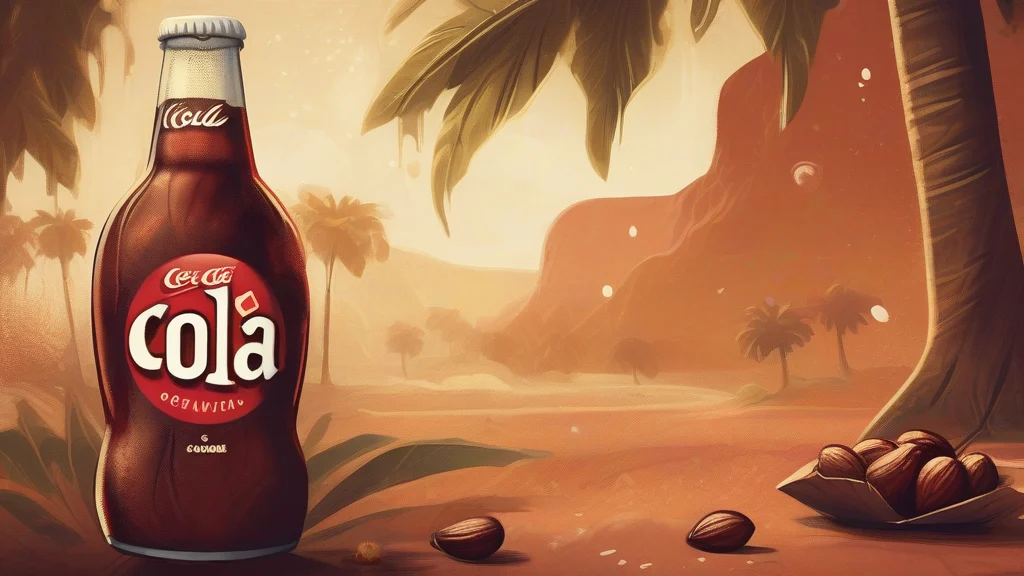
What does cola mean?
Cola is a sweet, brown, carbonated soft drink whose distinctive flavour derives originally from extracts of the kola nut — the caffeine-bearing seed of trees native to the rainforests of West Africa — blended with other flavourings such as vanilla, cinnamon, and citrus oils. The word doubles as a botanical term for the kola tree itself, genus Cola, whose nuts have long been chewed across West Africa as a mild stimulant and exchanged as tokens of hospitality. In modern usage, "cola" most commonly names the drink category generically, covering both branded products and their store-brand equivalents, as well as variants such as diet or cherry cola. It also serves as a mixer in drinks like rum and cola. Because the leading brands are trademarks, "cola" offers writers a convenient generic term, much as "xerox" or "kleenex" do not. The word entered English in the late nineteenth century alongside the commercial drinks it named.
A sweet, carbonated soft drink flavoured with kola-nut extract and other flavourings.
"The vending machine sold water, juice, and several brands of cola."
A tropical West African tree of the genus Cola, or its seed (the kola nut), which contains caffeine.
"Botanists classify the kola tree under the genus Cola, family Malvaceae."
This sense appears chiefly in scientific and historical writing; colloquially the nut is called a "kola nut."
Used when referring to multiple drinks, cans, or brands of cola.
"The fridge was stocked with colas of every brand."
Coca-Cola got its name because two of its original ingredients were coca leaves and kola nuts — making "cola" literally a piece of West Africa bottled into an American icon.
Reviewed by Deb Chak, Editor. AI-assisted content curated by RJS Tech Solutions LLP.
Etymology of cola
The word "cola" comes ultimately from Temne kɔ́lâ (or a closely related West African language), the native name for the caffeine-rich nut of the kola tree, Cola acuminata. European naturalists Latinised the indigenous name as the genus name Cola, and English borrowed both the botanical term and the drink-related form during the late nineteenth century, when American soft-drink makers began using kola-nut extract — famously in Coca-Cola, named partly for its coca leaf and kola nut ingredients. The drink sense has since become the dominant one worldwide, while the underlying word remains a rare example of an everyday English term rooted in a West African language.
How cola is actually used
In everyday use, "cola" almost always means the soft drink, often generically for any brand in that flavour category (as opposed to a specific trademark like Coke or Pepsi). In American English it falls under the broader term "soda" or "pop" depending on region. The botanical sense (the tree) appears mainly in scientific, historical, or food-history contexts. Plural is "colas" when referring to drinks or bottles.
Easily confused with cola
"Kola" refers to the caffeine-containing nut itself or the tree it comes from, while "cola" usually means the soft drink flavoured with kola extract.