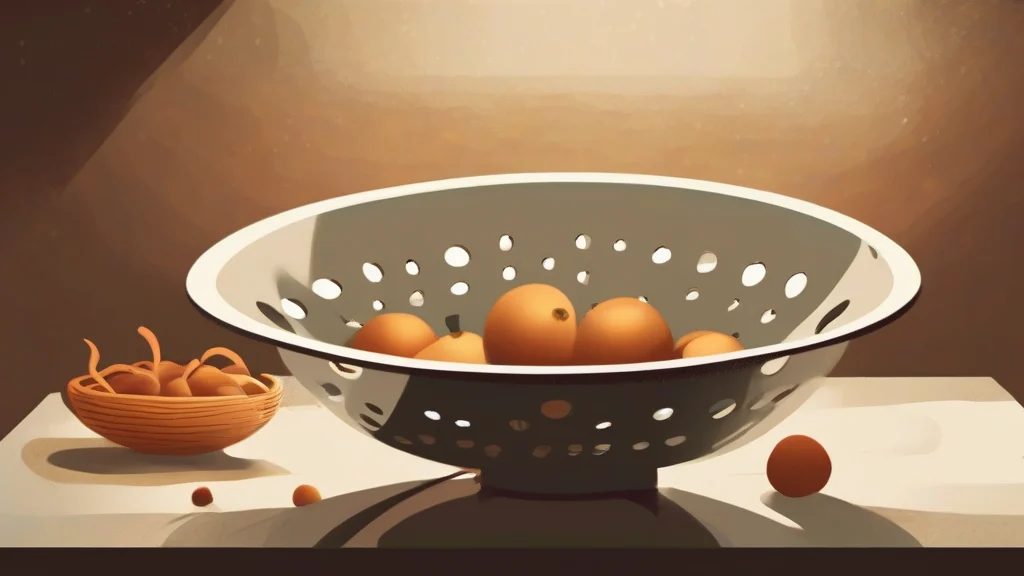
What does colander mean?
A colander is a bowl-shaped kitchen implement pierced with holes or slits, used chiefly to drain liquid away from food and to rinse fruits, vegetables, and salads. Its wide basin and stable base allow it to sit independently in a sink or on a counter, distinguishing it from flat strainers and fine-mesh sieves, which serve more specialized purposes. The word entered English in the early seventeenth century, borrowed via Middle French from Latin 'colare', meaning to strain or filter — a lineage it shares etymologically with words built on the root 'colare'. Colanders are made from stainless steel, plastic, silicone, or enamelware, and are found in virtually every domestic and professional kitchen. Though humble, the word is precise and well established: cooks rely on it daily, and recipes routinely instruct the reader to drain pasta, blanch vegetables, or wash greens 'in a colander'. It carries no emotional connotation; it is simply an indispensable, unglamorous workhorse of culinary vocabulary.
nounA bowl-shaped kitchen utensil with perforations or holes, used for draining liquids from food such as pasta or washing vegetables.
- A perforated bowl-shaped utensil used in cooking for draining liquid from food or rinsing produce.
"She tipped the steaming spaghetti into the colander and gave it a quick shake."
"After boiling the potatoes, he poured them into the colander to let the water run off."
"Rinse the fresh berries gently under cold water in a colander before serving."
Standard regular plural formation.
"The commercial kitchen had several large colanders stacked beside the sink."
The word 'colander' comes from Latin 'colare', meaning to strain — so every time you drain your pasta, you're using a tool named after the very act itself.
Reviewed by Deb Chak, Editor. AI-assisted content curated by RJS Tech Solutions LLP.
Etymology of colander
Colander derives ultimately from the Latin verb 'colare', meaning to strain or filter, which in turn comes from the noun 'column' in its sense of a sieve-like apparatus. The word reached English in the early seventeenth century by way of Middle French 'couloir' or Italian 'colatore', both carrying the same Latin root. This root also gives us related vocabulary such as 'collocate' and 'cullender', an older British variant of the same word that has largely fallen out of use.
How colander is actually used
A common everyday household term with no particular register — used naturally in both casual conversation and recipe writing. In British English an older variant spelling, 'cullender', is now rare but occasionally encountered in older texts.
Easily confused with colander
A sieve is a finer meshed implement used mainly for sifting dry ingredients, while a colander is a larger bowl with bigger holes designed for draining liquids.
A strainer is typically a shallow mesh basket held over the sink or pot, whereas a colander is a deep freestanding bowl that can rest on its own base.