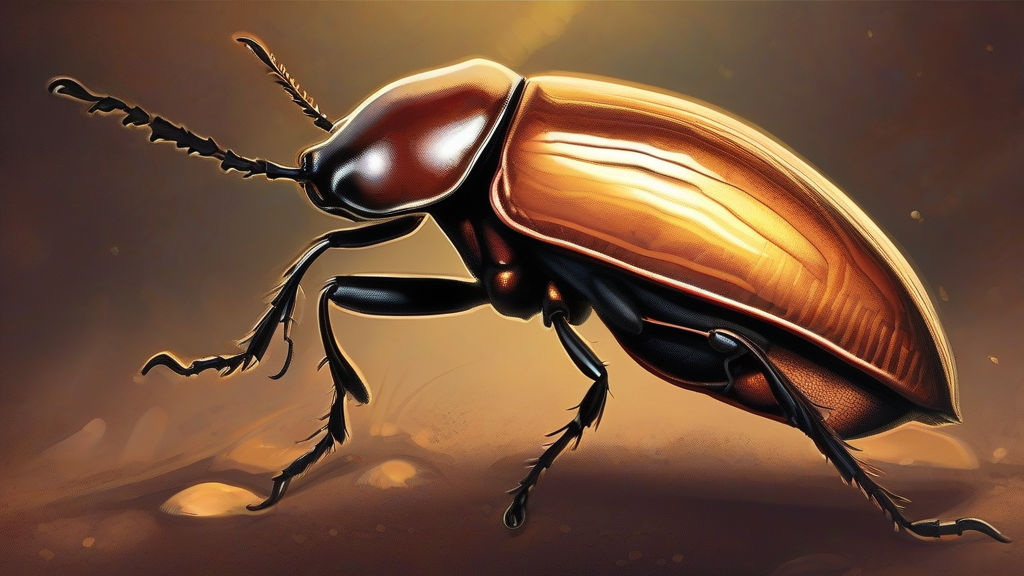
What does coleopteran mean?
A coleopteran is any member of Coleoptera, the insect order commonly known as beetles. With roughly 350,000 described species, Coleoptera is the largest order in the animal kingdom, making coleopterans extraordinarily abundant and diverse. The name reflects the group's defining feature: the Greek-derived elements mean 'sheath-winged,' referring to the elytra, the thickened forewings that fold over the delicate hind wings like protective cases. Coleopterans occur in nearly every habitat, from deserts to freshwater, feeding on plants, fungi, detritus, or other animals. In everyday speech people simply say 'beetle'; 'coleopteran' appears chiefly in scientific writing, nature documentaries, and formal description. Related terms include 'coleopterous' (adjective) and 'coleopterist' (a student or specialist of beetles).
nounAn insect of the order Coleoptera; a beetle, characterized by hardened forewings (elytra) that cover and protect the folded hind wings.
- Any insect of the order Coleoptera; a beetle.
"The field guide devoted its largest chapter to coleopterans, which outnumber all other known animal species."
"The entomologist catalogued over two hundred coleopteran species in a single summer of fieldwork."
"Because their elytra form a protective shell, coleopterans can thrive in habitats too harsh for most other insects."
Standard regular plural; also treated as an adjective in phrases like 'coleopteran species.'
"Many coleopterans rely on chemical defenses rather than flight to escape predators."
Roughly one in every four known animal species on Earth is a coleopteran — beetles are so diverse that the biologist J. B. S. Haldane reportedly quipped that God must have 'an inordinate fondness for them.'
Reviewed by Deb Chak, Editor. AI-assisted content curated by RJS Tech Solutions LLP.
Etymology of coleopteran
The word derives from New Latin 'Coleoptera,' the scientific order name coined in the eighteenth century from ancient Greek 'koleos' (sheath) plus 'pteron' (wing), literally meaning 'sheath-winged.' It entered English as a noun in the nineteenth century alongside other zoological terms built on Greek roots. The element '-pteran' connects it to cognates such as 'helicopter' ('spiral wing') and 'pterodactyl' ('winged finger'), while 'coleopterist' denotes a specialist who studies beetles.
How coleopteran is actually used
Primarily used in formal, scientific, or technical contexts such as entomology; 'beetle' is the ordinary everyday term.
Easily confused with coleopteran
A lepidopteran is a butterfly or moth of the order Lepidoptera, whereas a coleopteran is a beetle of the order Coleoptera.