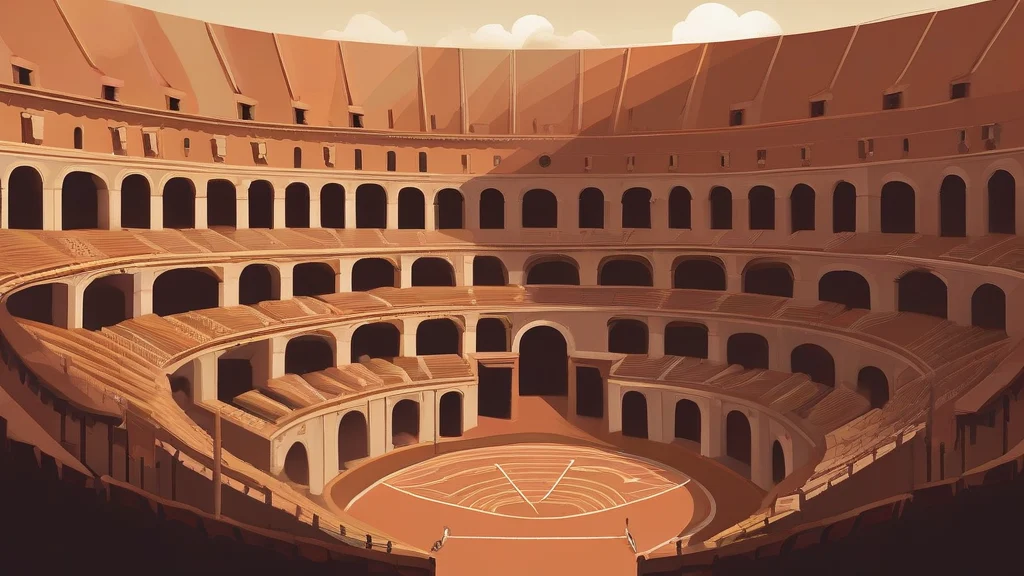
What does coliseum mean?
A coliseum is a large structure or open-air arena designed to host public spectacles such as sporting events, concerts, and performances. In its most familiar capitalized form, the Colosseum names the vast ancient amphitheatre built in Rome during the first century AD, once the stage for gladiatorial combat before crowds of tens of thousands. Lowercase, the word functions as a general term for any imposing entertainment venue, particularly in North America, where numerous arenas and stadiums carry the name. The word evokes scale, spectacle, and drama, whether describing a packed modern arena or weathered Roman ruins. It derives ultimately from the Greek 'kolossos', meaning a colossal statue, a nod to the enormous statue of Emperor Nero that once stood near the Roman amphitheatre. Related English words include 'colossal' and 'colossus'. Writers typically use it interchangeably with 'arena' or 'amphitheatre' when a tone of grandeur suits the context.
A large building or open-air venue used for public entertainments such as sports events and concerts.
"The ice show drew families from across the region to the downtown coliseum."
Common in American usage for civic arenas; often part of proper venue names.
Specifically, the ancient Flavian Amphitheatre in Rome, usually styled the Colosseum, famed for gladiatorial contests in antiquity.
"Standing beneath the crumbling arches of the Colosseum, she imagined the roar of fifty thousand spectators."
When referring to this specific monument, both 'the Colosseum' and 'the Coliseum' are widely accepted spellings, though 'Colosseum' is preferred in scholarly contexts.
The standard plural adds -s. It applies to multiple modern venues; the Roman Colosseum, being unique, has no meaningful plural.
"The touring company performed in three different coliseums on its cross-country route."
The word 'coliseum' was born from a giant — it derives from the Greek 'kolossos', meaning a colossal statue, because Rome's amphitheatre stood beside a towering bronze statue of Nero.
Reviewed by Deb Chak, Editor. AI-assisted content curated by RJS Tech Solutions LLP.
Etymology of coliseum
The word coliseum comes from medieval Latin 'coliseus' (also 'coliseum'), applied to the great Roman amphitheatre completed around AD 80. The name derives from Latin 'colosseus', meaning gigantic or colossal, which itself comes from the Greek 'kolossos', denoting a colossal statue — a reference to the massive bronze statue of Emperor Nero erected nearby. Over time, the proper name of the Roman monument became generalized into a common noun for any large arena or place of public entertainment.
How coliseum is actually used
Lowercase 'coliseum' is a generic term for any big entertainment venue and is common in American English, where many arenas bear the name. Capitalized as 'the Colosseum', it denotes specifically the ancient Roman amphitheatre, though lowercase 'coliseum' is also widely accepted when referring to that monument. The word carries connotations of grandeur and spectacle.
Easily confused with coliseum
The Colosseum (capitalized) refers specifically to the ancient Flavian Amphitheatre in Rome, while coliseum is the general term for any large entertainment venue.