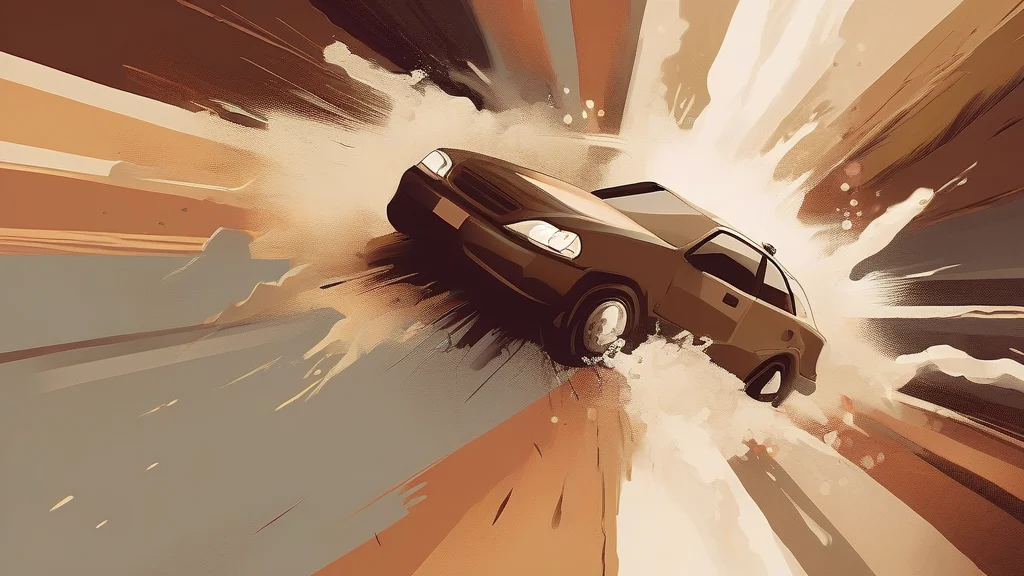
What does colliding mean?
"Colliding" is the present participle and gerund of the verb "collide," describing the act of moving objects striking one another with force, or — figuratively — opposing ideas, interests, or groups coming into direct conflict. In physical contexts it appears everywhere from traffic reports to particle physics, as in subatomic particles colliding inside an accelerator. In figurative use it lends drama and inevitability to a clash: colliding schedules, colliding ambitions, colliding worldviews. The word derives from Latin "collidere," formed from "com-" (together) and "laedere" (to strike or injure), the latter also giving English "lesion." Because the base verb already implies mutual impact, "colliding" suggests motion toward contact rather than a one-sided blow, distinguishing it from simpler terms like "hitting." It is neutral in register, equally at home in scientific writing, journalism, and everyday speech.
Striking together with force, or coming into conflict.
"The geologists studied evidence of continents colliding millions of years ago."
Used in progressive constructions such as "is colliding" or "were colliding."
The action or process of crashing together or coming into conflict.
"The colliding of rival empires shaped the region's borders for centuries."
Every colliding car on the road owes its crumpled fender to a Latin verb meaning 'to strike together' — the same root that gives doctors the word 'lesion.'
Reviewed by Deb Chak, Editor. AI-assisted content curated by RJS Tech Solutions LLP.
Etymology of colliding
"Colliding" descends from Latin "collidere," meaning "to strike or clash together," built on "com-" (together) and "laedere" (to strike, hurt). The verb entered English in the early seventeenth century, initially in learned or technical use before broadening into everyday language. Its root "laedere" survives elsewhere in English chiefly in "lesion." The noun "collision" developed alongside the verb as its natural derivative.
Related word forms
How colliding is actually used
"Colliding" functions both as the progressive form of the verb ("the cars are colliding") and as a gerund/noun ("the colliding of tectonic plates"). It carries a connotation of forceful, often destructive impact, and is frequently used figuratively for abstract clashes such as competing priorities or worldviews.
Easily confused with colliding
"Colluding" means secretly cooperating for a dishonest purpose, while "colliding" means crashing together in conflict or impact.